 Toppers Study Toppers Study Toppers Study
Get complete NCERT Solutions for 10 Science 12. Electricity with detailed explanations. Easy-to-understand answers to help students study effectively and score better.
Get complete NCERT Solutions for 10 Science 12. Electricity with detailed explanations. Easy-to-understand answers to help students study effectively and score better.
Preparing for exams becomes easier with Text-book Questions. Whether you are studying for board exams or mid-term exams, 10 Science Chapter 12. Electricity solutions provide quick revising points, well-structured answers, and additional practice material to help you score better.
ncert_solutionsPage no. 200
Q1. What does an electric circuit mean?
Ans: A continuous and closed path of an electric current is called an electric circuit. In which various electric components are arranged in series or parrallel.
Q2. Define the unit of current.
Ans: S.I unit of current is Ampere, which denoted by Letter 'A'. Ampere is defined as "When one coulomb of charge flows in one second it is callled one Ampere of current".
Q3. Calculate the number of electrons constituting one coulomb of charge.
Ans: One electron possesses a charge of 1.6 × 10⁻¹⁹ C,
Therefore, Charge on 1 electron = 1.6 × 10⁻¹⁹ C
Total Charge = 1 coulomb = 1C (given)
The number of elecrons = ?
Total Charge = number of electrons × Charge on 1 electron
1C = number of electrons × 1.6 × 10⁻¹⁹ C
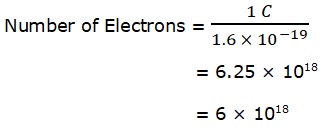
The number of electrons constituting one coulomb of charge is 6 × 10¹⁸
Page no. 202
Q1. Name a device that helps to maintain a potential difference across a conductor.
Ans: Cell or Battery is a device that helps to maintain a potential difference across a conductor.
Q2. What is meant by saying that the potential difference between two points is 1 V?
Ans: If 1 J of work is required to move a charge of amount 1 C from one point to another then it is said that the potential difference between the two point is 1 V.
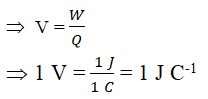
Q3. How much energy is given to each coulomb of charge passing through a 6 V battery?
Ans: The energy given to each coulomb of charge is equal to the amount of work done to move it.
V = W/Q

Page no. 209
Q1. On what factors does the resistance of a conductor depend?
Q2. Will current flow more easily through a thick wire or a thin wire of the same material, when connected to the same source? Why?
Q3. Let the resistance of an electrical component remains constant while the potential difference across the two ends of the component decreases to half of its former value. What change will occur in the current through it?
Q4. Why are coils of electric toasters and electric irons made of an alloy rather than a pure metal?
Q5. Use the data in Table 12.2 to answer the following –
(a) Which among iron and mercury is a better conductor?
(b) Which material is the best conductor?
Page no. 213
Q1. Draw a schematic diagram of a circuit consisting of a battery of three cells of 2 V each, a 5 Ω resistor, an 8 Ω resistor, and a 12 Ω resistor, and a plug key, all connected in series.
Q2. Redraw the circuit of Question 1, putting in an ammeter to measure the current through the resistors and a voltmeter to measure the potential difference across the 12 Ω resistor. What would be the readings in the ammeter and the voltmeter?
Page no. 216
Q1. Judge the equivalent resistance when the following are connected in parallel – (a) 1 Ω and 106 Ω, (b) 1 Ω and 103 Ω, and 106 Ω.
Q2. An electric lamp of 100 Ω, a toaster of resistance 50 Ω, and a water filter of resistance 500 Ω are connected in parallel to a 220 V source. What is the resistance of an electric iron connected to the same source that takes as much current as all three appliances, and what is the current through it?
Q3. What are the advantages of connecting electrical devices in parallel with the battery instead of connecting them in series?
Q4. How can three resistors of resistances 2 Ω, 3 Ω, and 6 Ω be connected to give a total resistance of (a) 4 Ω, (b) 1 Ω?
Q5. What is (a) the highest, (b) the lowest total resistance that can be secured by combinations of four coils of resistance 4 Ω, 8 Ω, 12 Ω, 24 Ω?
Page no. 218
Q1. Why does the cord of an electric heater not glow while the heating element does?
Q2. Compute the heat generated while transferring 96000 coulomb of charge in one hour through a potential difference of 50 V.
Q3. An electric iron of resistance 20 Ω takes a current of 5 A. Calculate the heat developed in 30 s.
Page no. 220
Q1. What determines the rate at which energy is delivered by a current?
Q2. An electric motor takes 5 A from a 220 V line. Determine the power of the motor and the energy consumed in 2 h
Text-book Questions are created by experts to give step-by-step explanations. Around 60–70% of exam questions are based on NCERT concepts. Our 10 Science Chapter 12. Electricity solutions help you understand the core concepts and practice effectively.
Revision is the key to exam success. Our notes for 10 Science highlight important formulas, key definitions, and exam-ready points from Chapter 12. Electricity. These quick revision notes make last-minute preparation easy.
Every NCERT chapter ends with exercises, and solving them is crucial. Our Text-book Questions include complete solutions for 10 Science Chapter 12. Electricity exercises. With step-by-step answers, you gain clarity and confidence to attempt similar exam questions.
To boost your preparation, we also provide additional important questions with answers. These are prepared from previous year board papers, sample papers, and important concepts of Chapter 12. Electricity. Practicing these ensures you are well-prepared for both board and mid-term exams.
Our Text-book Questions are useful for both board exams and mid-term exams. For 10 Science, we provide notes, exercises, and important Q&A so that you can revise smartly and write perfect answers in exams.
In short, Text-book Questions for 10 Science Chapter 12. Electricity are a complete study package. With quick revising points, NCERT exercises, and additional important questions, you can prepare effectively for exams. Make these solutions your study companion and excel in your academic journey.
Go to other Class
Download worksheets and assignments for better practice and revision.