 Toppers Study Toppers Study Toppers Study
Detailed NCERT Solutions for 11 Mathematics 10. Straight Lines to simplify learning. Understand chapters clearly and practice with free solutions for better results.

Detailed NCERT Solutions for 11 Mathematics 10. Straight Lines to simplify learning. Understand chapters clearly and practice with free solutions for better results.
Preparing for exams becomes easier with Exercise 10.3. Whether you are studying for board exams or mid-term exams, 11 Mathematics Chapter 10. Straight Lines solutions provide quick revising points, well-structured answers, and additional practice material to help you score better.
ncert_solutionsExercise 10.3
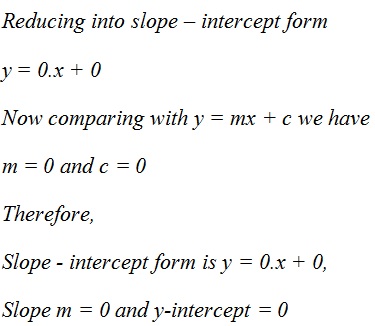
Q1. Reduce the following equations into slope - intercept form and find their slopes and the y - intercepts.
(i) x + 7y = 0,
(ii) 6x + 3y – 5 = 0,
(iii) y = 0.
Solution:
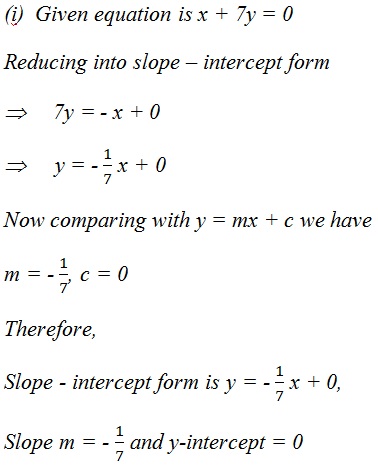
Solution:
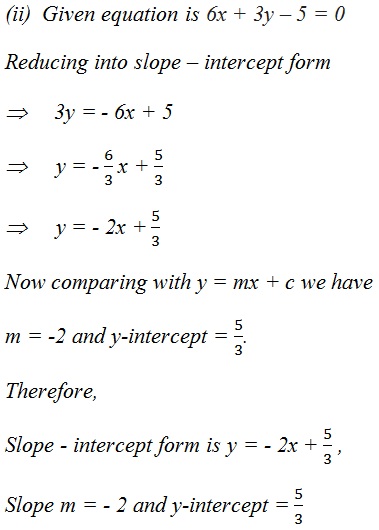
Solution:
(iii) y = 0
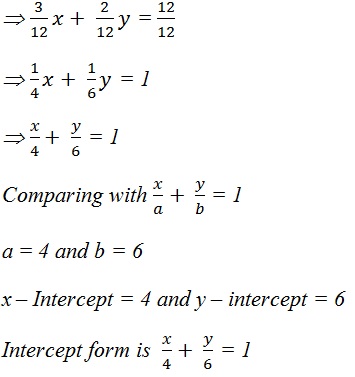
Q2. Reduce the following equations into intercept form and find their intercepts on the axes.
(i) 3x + 2y – 12 = 0
(ii) 4x – 3y = 6
(iii) 3y + 2 = 0.
Solution: (i) 3x + 2y – 12 = 0
Reducing into intercept form
3x + 2y = 12
Dividing by 12
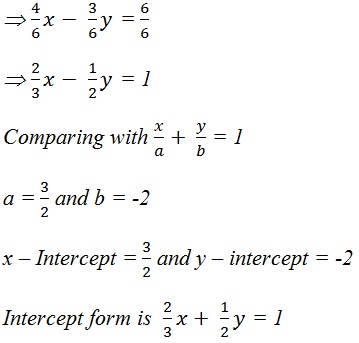
Solution: (ii) 4x – 3y = 6
Reducing equation into intercept form
4x – 3y = 6
Dividing by 6
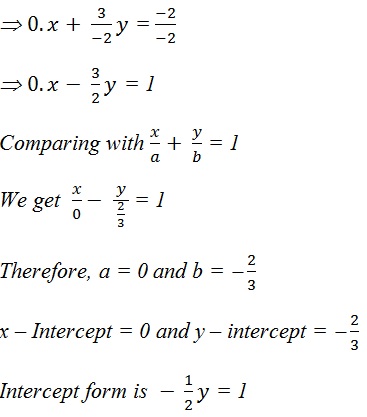
Solution: (iii) 3y + 2 = 0
Reducing equation into intercept form
0.x + 3y = - 2
Dividing by -2
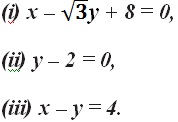
Q3. Reduce the following equations into normal form. Find their perpendicular distances from the origin and angle between perpendicular and the positive x-axis.
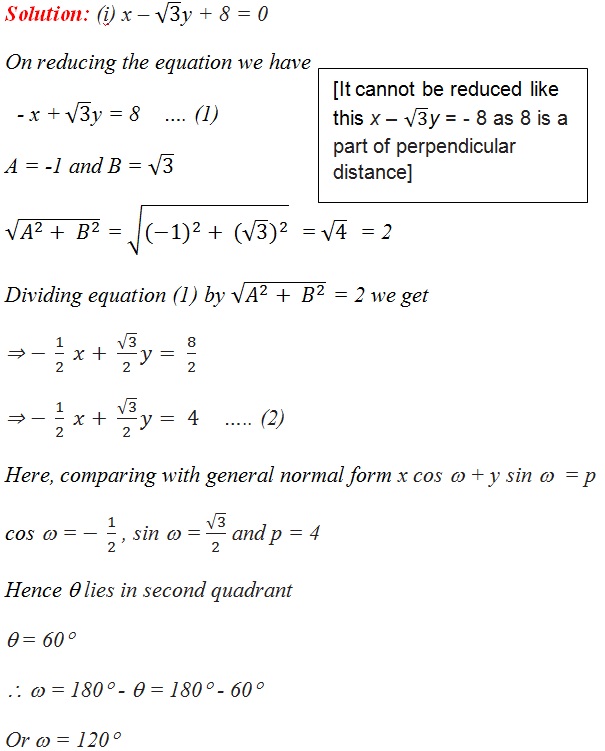
Required normal form of the line.
X cos 120° + y sin 120° = 4
Perpendicular distance (p) = 4
And angle between perpendicular and the positive x-axis = 120°
Solution: (ii) y – 2 = 0
On reducing the equation we have
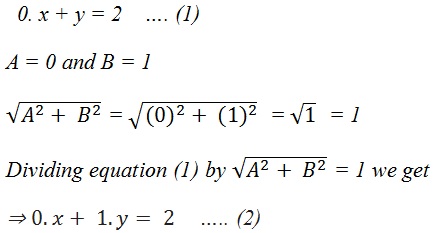
Here, comparing with general normal form x cos ω + y sin ω = p
cos ω = , sin ω = and p = 2
Hence point lies on y-axis and θ is in I quadrant.
θ = 90°
∴ ω = 90°
Required normal form of the line.
X cos 90° + y sin 90° = 2
Perpendicular distance (p) = 2
And angle between perpendicular and the positive x-axis = 90°
∴ ω θ
Solution: (iii) x – y = 4
On reducing the equation we have
x - y = 2 …. (1)
A = 1 and B = -1
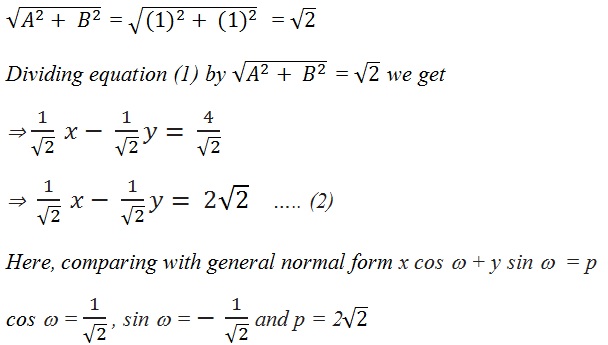
Hence ω lies in VI quadrant.
θ = 45° [ θ is value of angle between 0 - 90°]
∴ ω = 360° - θ = 360° - 45° = 315°
Required normal form of the line.
x cos 315° + y sin 315° = 2
Perpendicular distance (p) = 2
And angle between perpendicular and the positive x-axis = 315°
Q4. Find the distance of the point (–1, 1) from the line 12(x + 6) = 5(y – 2).
Solution:
Given line is 12(x + 6) = 5(y – 2) which gives
⇒ 12(x + 6) = 5(y – 2)
⇒ 12x + 72 = 5y – 10
⇒ 12x – 5y + 72 + 10 = 0
⇒ 12x – 5y + 82 = 0 ….. (1)
On comparing equation (1) with general equation of line Ax + By + C = 0, we obtain
A = 12, B = - 5 and C = 82
Now distance from given point (-1, 1) to line 12x – 5y + 82 = 0 given by
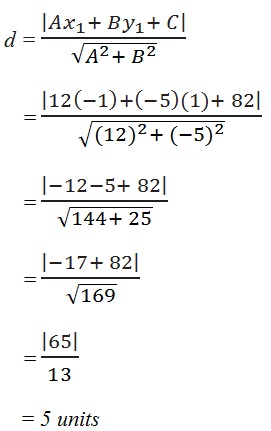

Solution:
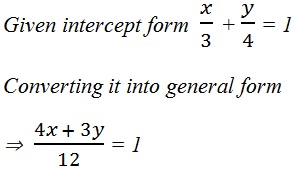
⇒ 4x + 3y = 12
⇒ 4x + 3y - 12 = 0 …..(1)
Comparing equation (1) with general equation of line Ax + By + C = 0
We obtain, A = 4, B = 3 C = -12
Let the point on x-axis be (a, 0) whose distance from given line is 4 units.
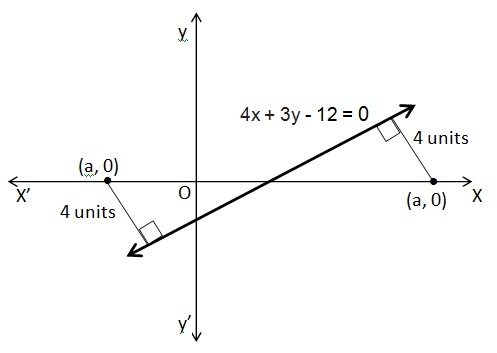
Using perpendicular distance formula;
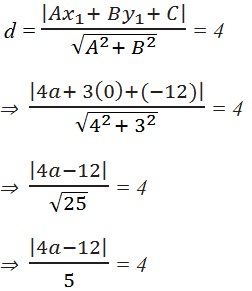
⇒ ±(4a – 12) = 20
Here we take both +ve and –ve signs
⇒ 4a – 12 = 20 Or – 4a + 12 = 20
⇒ 4a = 32 Or – 4a = 20 – 12
⇒ 4a = 32 Or – 4a = 20 – 12 = 8
⇒ a = 8 or a = – 2
Thus the required point on x-axis are (8, 0) and (-2, 0)
Q6. Find the distance between parallel lines
(i) 15x + 8y – 34 = 0 and 15x + 8y + 31 = 0
(ii) l (x + y) + p = 0 and l (x + y) – r = 0.
Solution:
(i) 15x + 8y – 34 = 0 and 15x + 8y + 31 = 0
Q12. Two lines passing through the point (2, 3) intersects each other at an angle of 60°. If slope of one line is 2, find equation of the other line.
Solution:
The slope of one line m1 = 2,
Let the slope of other line be m2.
And the angle between two lines is 60°
⇒ θ = 60°
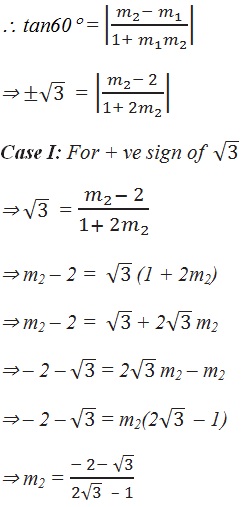
Now equation of the given live which passes through (2, 3)
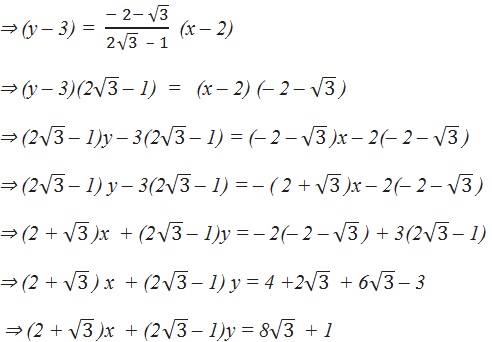
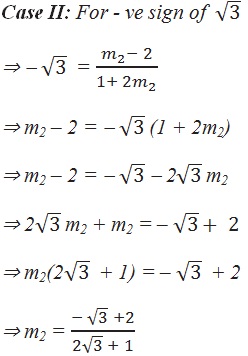
Now equation of the given live which passes through (2, 3)
Q13. Find the equation of the right bisector of the line segment joining the points (3, 4) and (–1, 2).
Solution:
Right bisector means perpendicular bisector of given line segment are A(3, 4) and B(-1, 2).
∵ Line bisects AB
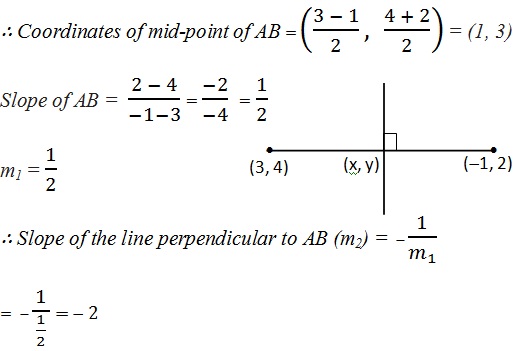
The equation of the line passing through (1, 3) and having a slope of –2 is
(y – 3) = –2 (x – 1) y – 3 = –2x + 2
2x + y = 5
Thus, the required equation of the line is 2x + y = 5.
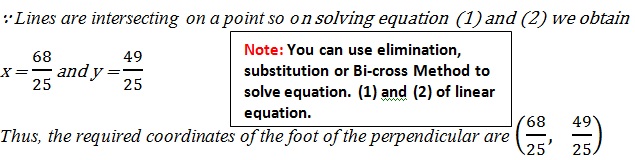
Q14. Find the coordinates of the foot of perpendicular from the point (–1, 3) to the line 3x – 4y – 16 = 0.
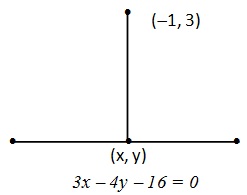
Solution:
Equation of given line is
3x – 4y – 16 = 0 …………. (1)
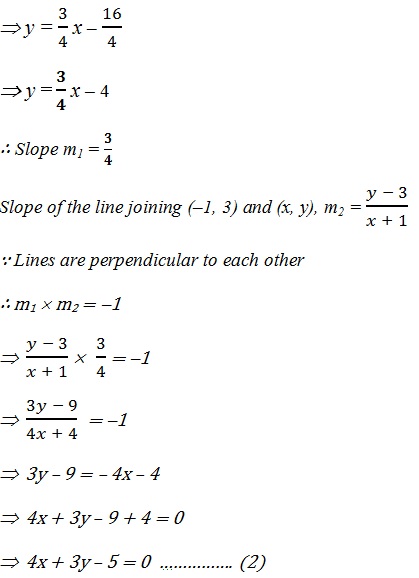
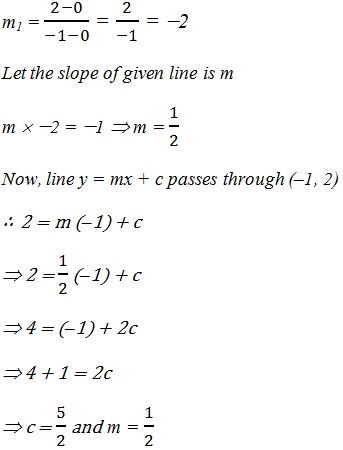
Q15. The perpendicular from the origin to the line y = mx + c meets it at the point (–1, 2). Find the values of m and c.
Solution:
Slope of perpendicular line from origin (0, 0) and (–1, 2).
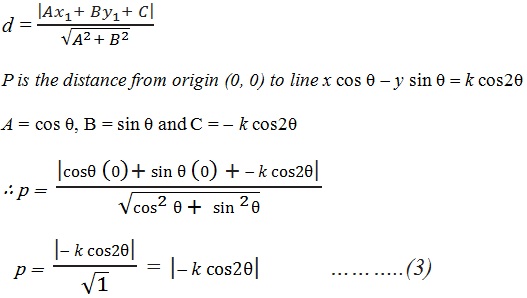
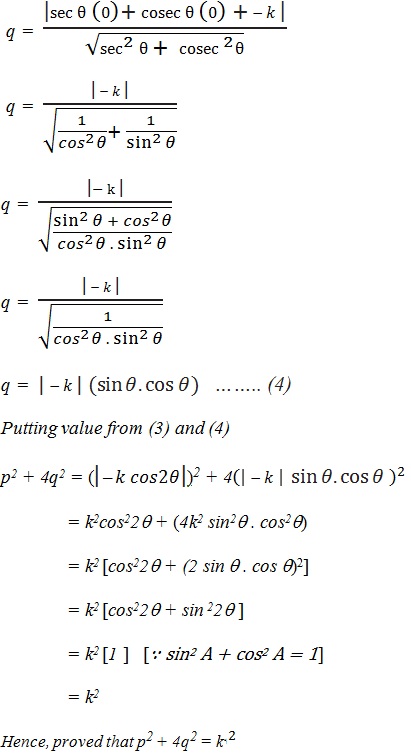
Q16. If p and q are the lengths of perpendiculars from the origin to the lines x cosθ - ysin θ = k cos2θ and x sec θ + y cosec θ = k, respectively, prove that p2 + 4q2 = k2.
Solution:
x cos θ – y sinθ = k cos 2θ ………………. (1)
x secθ + y cosec θ = k ………………….… (2)
The perpendicular distance (d) of a line Ax + By + C = 0 from a point (x1, y1) is given by
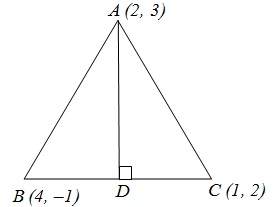
Q17. In the triangle ABC with vertices A (2, 3), B (4, –1) and C (1, 2), find the equation and length of altitude from the vertex A.
Solution:
ABC is the triangle which vertices are A (2, 3), B (4, –1) and C (1, 2).
AD is altitude on side BC from vertex A.
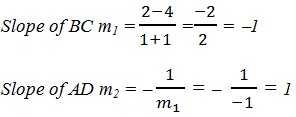
Equation for Altitude AD
⇒ (y – 3) = 1 (x – 2)
⇒ y – 3 = x – 2
⇒ x – y – 2 + 3 = 0
⇒ x – y + 1 = 0
The required equation of Altitude is x – y + 1 = 0.
Now equation for line BC where slope is – 1.
⇒ (y + 1) = –1 (x – 4)
⇒ y + 1 = – x + 4
⇒ x + y + 1 – 4 = 0
⇒ x + y – 3 = 0
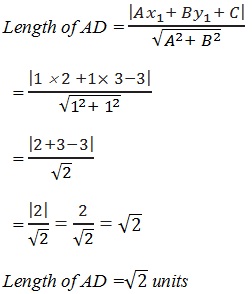
Length of AD = Length of the perpendicular from A (2, 3) to BC The equation of BC is x + y – 3 = 0
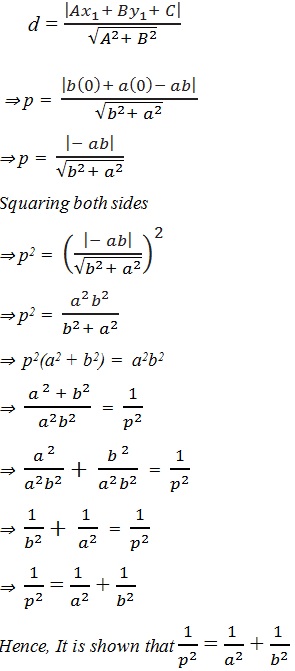
Exercise 10.3 are created by experts to give step-by-step explanations. Around 60–70% of exam questions are based on NCERT concepts. Our 11 Mathematics Chapter 10. Straight Lines solutions help you understand the core concepts and practice effectively.
Revision is the key to exam success. Our notes for 11 Mathematics highlight important formulas, key definitions, and exam-ready points from Chapter 10. Straight Lines. These quick revision notes make last-minute preparation easy.
Every NCERT chapter ends with exercises, and solving them is crucial. Our Exercise 10.3 include complete solutions for 11 Mathematics Chapter 10. Straight Lines exercises. With step-by-step answers, you gain clarity and confidence to attempt similar exam questions.
To boost your preparation, we also provide additional important questions with answers. These are prepared from previous year board papers, sample papers, and important concepts of Chapter 10. Straight Lines. Practicing these ensures you are well-prepared for both board and mid-term exams.
Our Exercise 10.3 are useful for both board exams and mid-term exams. For 11 Mathematics, we provide notes, exercises, and important Q&A so that you can revise smartly and write perfect answers in exams.
In short, Exercise 10.3 for 11 Mathematics Chapter 10. Straight Lines are a complete study package. With quick revising points, NCERT exercises, and additional important questions, you can prepare effectively for exams. Make these solutions your study companion and excel in your academic journey.
Go to other Class
Download worksheets and assignments for better practice and revision.