 Toppers Study Toppers Study Toppers Study
Get CBSE Notes for Class 9 Science – 12. Sound: Sound Wave. Clear, exam-focused notes with key concepts, formulas & solved examples.
CBSE Notes for Class 9 Science chapter 12. Sound: Sound Wave, quick revision notes for Class 9 Science chapter 12. Sound Sound Wave, Chapter-wise CBSE Revision Notes, CBSE Notes PDF Free Download, CBSE One Liner Notes Class 9, Half Yearly Revision Notes, CBSE Revision Notes Class 9 Science
Get CBSE Notes for Class 9 Science Chapter 12. Sound: Sound Wave prepared by experts as per the latest NCERT syllabus and CBSE exam pattern. These concise and easy-to-understand notes cover important definitions, formulas, diagrams, and key concepts from the chapter to help students in quick revision and effective exam preparation. Whether you are studying for school tests, board exams, or competitive exams, these notes provide a reliable study resource. Designed in simple language with point-wise explanations, they save time and enhance learning efficiency. Download free PDF notes, explore solved examples, and strengthen your understanding of [Topic Name] for scoring high marks. Perfect for Class 9 students who want clear, structured, and exam-oriented notes for CBSE Science.
Sound Wave : Sound is known as the wave and wave is disturbance which is produced by a vibrating object. These wave are longitudinal wave which create by compression and rarefaction.
Sound wave is mechanical wave: Sound waves need medium to propagate from one place to another, in otherhand it need body for transmission, this is the reason that sound waves are called mechanical waves.
Common medium for the propagation of sound : Air is common medium.
Sound waves are longitudinal waves:
Sound wavves are longitudinal waves because the displacement of particles of medium occure parallel to the direction of propagation in these waves. The particles do not move from one place to another but they oscillate in to and fro motion ramain about mean position as the waves travel. Just like this sound waves propagate, therefore sound waves are longitudinal waves.
Features of sound waves:
There are following features of sound waves:
(i) Frequency
(ii) Amplitude
(iii) Velocity
Wavelength : The distance between two consecutive compressions (C) or two consecutive rarefactions (R) is called the wavelength.
Or the distance covered by a wave to complete an oscillation is called wavelength.
Hence wavelength is kind of length, therefore the S.I unit of wavelength is metre (m).
Wavelength is represented by Greek letter λ (lambda).
Frequency: The number of oscillation completed in one second is called frequency.
S.I unit of frequncy is Hertz(Hz).
Time Period : The time taken to complete one oscillation is called it's time period.

Amplitude : The maximum displacement of the particles of medium from their original undisturbed position (equilibrium position) during the propagation of wave is called amplitude.
Amplitude is denoted by A and its SI unit is metre (m).
Representing graphically the density and pressure variations.
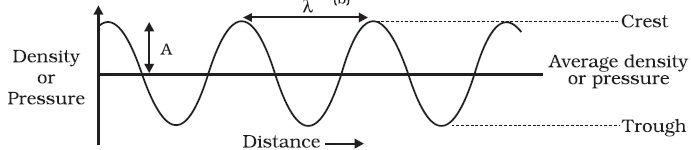
Sound have characteristics like pitch, loudness and timbre.
Crest: A pick of sound wave is called crest.
Trough: A valley of the sound wave is called trough.
Timbre : The quality or timber of sound is that characteristic which enables us to distinguish one sound from another having the same pitch and loudness.
Tone : A sound of single frequency is called a tone.
Note : The sound which is produced due to a mixture of several frequencies is called a note and is pleasant to listen.
Noise: The sound which is unpleasant to ear is called noise.
The speed of sound : The speed of sound is defined as the distance which a point on a wave, such as a compression or a rarefaction, travels per unit time.
Speed (v) = distance/time
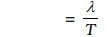
λ is wavelength
T is time period
or v = λ ν
That is, speed = wavelength × frequency.
Example 1. A sound wave has a frequency of 2 kHz and wave length
35 cm. Find the speed of sound.
Solution:
Given,
Frequency, ν = 2 kHz = 2000 Hz
Wavelength, λ = 35 cm = 0.35 m
Speed (v) = wavelength × frequency
= λ ν
= 0.35 × 2000
= 700 m/s
Therefore speed is 700 m/s
Example 2. Calculate the wavelength of a sound wave whose frequency is 220 Hz and speed is 440 m/s in a given medium.
Solution:
Frequency = 220 Hz
Speed = 440 m/s
Wavelength = speed/frequency
= 440/220
= 2 m
Therefore, wavelength is 2 m
Intensity of sound : The amount of sound energy passing each second through unit area is called the intensity of sound.
Loudness of sound : Loudness is a measure of the response of the
ear to the sound.
Factors on which the loudness of sound depends:
(i) Loudness of sound depends on apletudes of vibration.
For students preparing for board exams or competitive assessments, CBSE notes have become an indispensable tool. These notes summarize the NCERT textbooks, highlighting key concepts, formulas, definitions, and diagrams in a concise and easy-to-understand format. Unlike lengthy textbooks, CBSE notes allow students to focus on the most important points, saving valuable time during revision.
In conclusion, CBSE notes are not just a revision tool—they are a strategy. When used correctly, they help students cover the syllabus efficiently, improve retention, and approach exams with confidence. For exam-going students, the combination of structured notes, practice, and consistent revision is the key to achieving top results.
Ace your exams with CBSE Notes for Class 9 Science chapter 12. Sound: Sound Wave. These notes provide a clear explanation of important concepts, formulas, diagrams, and solved examples from the NCERT syllabus. Specially designed for Class 9 students, the notes are structured in a simple, point-wise manner to make revision quick and effective. Whether you are preparing for school tests, board exams, or competitive exams, these Science notes will boost your confidence and save valuable study time. You can also download Science class 9 chapter 12. Sound free PDF notes for offline learning. With easy-to-grasp language, exam tips, and well-organized content, these CBSE Science notes on chapter 12. Sound – Sound Wave are the perfect study companion for scoring high marks and mastering the subject.
CBSE class 10 Science notes are available completely free in PDF, and these all notes are quick revising materials that help you prepare for your upcoming board exams. Students can easily access CBSE notes pdf free download class 10 Science and get free CBSE notes class 10 Science notes designed strictly as per the latest NCERT syllabus. These Class 10 CBSE notes and Class 10 Science notes are short, simple, and to the point, making them perfect for last-minute revisions. You can also refer to NCERT book notes for class 10 that cover every chapter in an easy-to-understand manner. With these Quick revision notes Science class 10, you save time while covering all important formulas, definitions, and concepts.
Download worksheets and assignments for better practice and revision.