 Toppers Study Toppers Study Toppers Study
Get CBSE Notes for Class 9 Science – 8. Motion: Accelaration. Clear, exam-focused notes with key concepts, formulas & solved examples.
CBSE Notes for Class 9 Science chapter 8. Motion: Accelaration, quick revision notes for Class 9 Science chapter 8. Motion Accelaration, Chapter-wise CBSE Revision Notes, CBSE Notes PDF Free Download, CBSE One Liner Notes Class 9, Half Yearly Revision Notes, CBSE Revision Notes Class 9 Science
Get CBSE Notes for Class 9 Science Chapter 8. Motion: Accelaration prepared by experts as per the latest NCERT syllabus and CBSE exam pattern. These concise and easy-to-understand notes cover important definitions, formulas, diagrams, and key concepts from the chapter to help students in quick revision and effective exam preparation. Whether you are studying for school tests, board exams, or competitive exams, these notes provide a reliable study resource. Designed in simple language with point-wise explanations, they save time and enhance learning efficiency. Download free PDF notes, explore solved examples, and strengthen your understanding of [Topic Name] for scoring high marks. Perfect for Class 9 students who want clear, structured, and exam-oriented notes for CBSE Science.
Acceleration :
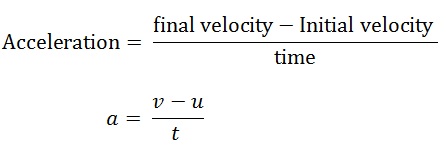
Acceleration is changing in the velocity of an object per unit time is called acceleration.
In other words:
The rate of changing in the velocity is known as acceleration.
Accelerated motion: If the velocity of an object changes from an initial value u to the final value v in time t, the acceleration is a, and this kind of motion is known as accelerated motion.
Example: A bus starts from rest and attains a speed of 72 km h-1 in 5 minutes while moving in uniform motion. Find the acceleration of the bus.
Solution:
Time (t) = 5 minites = 5 × 60 = 300 seconds
Initial velocity u = 0 [∵ bus was in rest]
Final velocity v = 72 km h-1
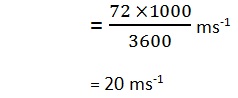
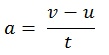
= (20 - 0)/300
= 0.066 ms-2
Acceleration of object = 0.066 ms-2
Type of accelerations are based on direction of acceleration:
These are:
(I) Positive acceleration
(II) Negative acceleration
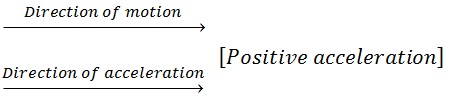
(I) Positive acceleration : If the velocity of an object increases with time in the direction of motion of the object, this is known as positive acceleration.
The direction of acceleration is same as the direction of motion.
Main points:
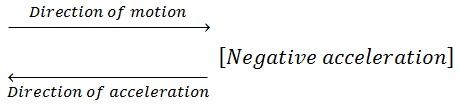
(II) Negative acceleration : If the velocity of an object decreases with time in an opposite direction of motion of the object, this is known as negative acceleration.
Retardation: Negative accelaration is known as retardation.
Main points:
Uniform accelaration: When the velocity of an object changes by an equal amount in equal intervals of time such a accelaration of the object is known as uniform accelaration.
Uniformly accelarated motion: The motion of an object having uniform accelaration is known as uniformly accelarated motion.
Examples:
(i) motion of a rolling ball on smooth surface.
(ii) The motion of a freely falling body.
(iii) Motion of the earth round the sun.
(iv) A high speed lift starts from multi-storied building.
(v) The motion of the moon round the Earth.
Non-uniform accelaration: When the velocity of an object changes by an unequal amount in equal intervals of time such a accelaration of the object is known as non-uniform accelaration.
Non-uniformly accelarated motion: The motion of an object having different accelaration is known as non-uniformly accelarated motion.
Examples:
(i) A racing car.
(ii) The motion of vehicles moving at differents speeds.
(iii) The ball is thrown upward at top it get retarded.
(iv) The motion of a bus passing through rough road.
For students preparing for board exams or competitive assessments, CBSE notes have become an indispensable tool. These notes summarize the NCERT textbooks, highlighting key concepts, formulas, definitions, and diagrams in a concise and easy-to-understand format. Unlike lengthy textbooks, CBSE notes allow students to focus on the most important points, saving valuable time during revision.
In conclusion, CBSE notes are not just a revision tool—they are a strategy. When used correctly, they help students cover the syllabus efficiently, improve retention, and approach exams with confidence. For exam-going students, the combination of structured notes, practice, and consistent revision is the key to achieving top results.
Ace your exams with CBSE Notes for Class 9 Science chapter 8. Motion: Accelaration. These notes provide a clear explanation of important concepts, formulas, diagrams, and solved examples from the NCERT syllabus. Specially designed for Class 9 students, the notes are structured in a simple, point-wise manner to make revision quick and effective. Whether you are preparing for school tests, board exams, or competitive exams, these Science notes will boost your confidence and save valuable study time. You can also download Science class 9 chapter 8. Motion free PDF notes for offline learning. With easy-to-grasp language, exam tips, and well-organized content, these CBSE Science notes on chapter 8. Motion – Accelaration are the perfect study companion for scoring high marks and mastering the subject.
CBSE class 10 Science notes are available completely free in PDF, and these all notes are quick revising materials that help you prepare for your upcoming board exams. Students can easily access CBSE notes pdf free download class 10 Science and get free CBSE notes class 10 Science notes designed strictly as per the latest NCERT syllabus. These Class 10 CBSE notes and Class 10 Science notes are short, simple, and to the point, making them perfect for last-minute revisions. You can also refer to NCERT book notes for class 10 that cover every chapter in an easy-to-understand manner. With these Quick revision notes Science class 10, you save time while covering all important formulas, definitions, and concepts.
Download worksheets and assignments for better practice and revision.