 Toppers Study Toppers Study Toppers Study
Get CBSE Notes for Class 10 Science – 12. Electricity: page 2 . Clear, exam-focused notes with key concepts, formulas & solved examples.
CBSE Notes for Class 10 Science chapter 12. Electricity: page 2 , quick revision notes for Class 10 Science chapter 12. Electricity page 2 , Chapter-wise CBSE Revision Notes, CBSE Notes PDF Free Download, CBSE One Liner Notes Class 10, Half Yearly Revision Notes, CBSE Revision Notes Class 10 Science
Get CBSE Notes for Class 10 Science Chapter 12. Electricity: page 2 prepared by experts as per the latest NCERT syllabus and CBSE exam pattern. These concise and easy-to-understand notes cover important definitions, formulas, diagrams, and key concepts from the chapter to help students in quick revision and effective exam preparation. Whether you are studying for school tests, board exams, or competitive exams, these notes provide a reliable study resource. Designed in simple language with point-wise explanations, they save time and enhance learning efficiency. Download free PDF notes, explore solved examples, and strengthen your understanding of [Topic Name] for scoring high marks. Perfect for Class 10 students who want clear, structured, and exam-oriented notes for CBSE Science.
Connecting resistors to a circuit:
The current through a conductor depends upon its resistance and the potential difference across its ends.
There are two methods of joining the resistors together.
(i) Series: When two or more resistances are joined end to end so that same current flows through each of them. The resistors connecting in such manner is called resistors connected in series.
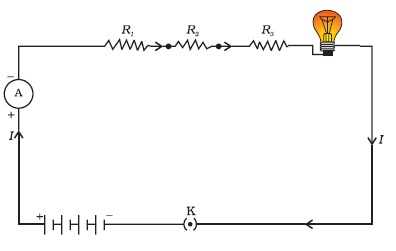
Resistors R1, R2 and R3 and a bulb are connected in series
Total Equivalent Resistance in Series:
When we connent resistors R1, R2 and R3 in series, the current (I) flowing through the resistance in series will remain same in every part of the circuit, where as the potential difference (V) across each resistor will be diffrerent.
The total potential difference across a combination of resistors inseries is equal to the sum of potential difference across the individual resistors.
Therefore,
V = V1 + V2 + V3 -------------------- (i)
When we apply Ohm's law
V = IR --------------------(ii)
So for each part we get;
V1 = I R1 -------------- (iii)
V2 = I R2 -------------- (iv)
V3 = I R3 -------------- (v)
Adding (iii) (iv) (v)
V1 + V2 + V3 = I R1 + I R2 + I R3
V = I (R1 + R2 + R3 ) using equation (i)
IR = I (R1 + R2 + R3 ) using equation (ii) (V = IR )
which gives
R = R1 + R2 + R3
Here R is total equivalent resistance in series which is equal to sums of individual resistances, R1, R2, R3, and is thus greater than any individual resistance.
(ii) Parallel: When two or more resistances are connected across two point so that each of them provides a seperate path for current, The resistors connecting in such manner is called resistors connected in parallel.
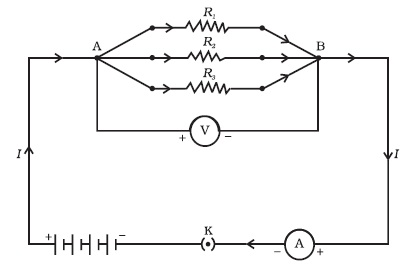
Resistors R1, R2 and R3 are connected in parallel.
Total Equivalent Resistance in parallel:
When we connect the resistors R1, R2 and R3 in parallel, The current (I) following in each resistors will be difference but the potential difference (V) across the each resistors will be same.
Therefore,
I = I1 + I2 + I3 -------------- (i) [current is difference in each resistor]
Let Rp be the equivalent resistance of the parallel combination of resistors.
By applying Ohm’s law to the parallel combination of resistors.
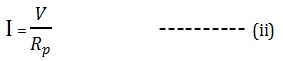
On applying Ohm’s law to each resistor, we have
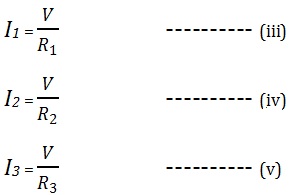
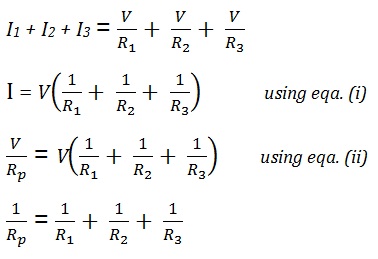
adding equation (iii) (iv) and (v)
Effect on current when resistors are connected in series:
Let, Two resistors R1 and R2 of 3 Ω and 5 Ω are connected in series to a 6 V battery. What will be toatal resistance of circuit and current through the circuit.
Total resistance in circuit
R = R1 + R2
= 3 Ω + 5 Ω
= 8 Ω
Now calculating for Current;
I = V/R
= 6/8
= 0.75 A
Effect on current when resistors are connected in parallel:
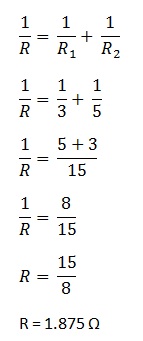
Same divices connected in parallel then resulting total resistance (R) and current (I)
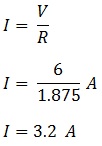
Now calculating for Current;
See these result in a table
| Resistor | Resistance | Current |
| Series | 8 Ω | 0.75 A |
| Parallel | 1.875 Ω | 3.2 A |
Battery: Connections of two or more than two cells is callled battery.
Ohm's Law: the electric current flowing through a metallic wire is directly proportional to the potential difference V, across its ends provided its temperature remains the same. This is called Ohm’s law.
V ∝ I
V ∝ I.constant
V/I = constant
= R
V = IR
Resistance
Heating Effect of electric current:
The chemical reaction within the cell generates the potential difference between
its two terminals that sets the electrons in motion to flow the current through a resistor or a system of resistors connected to the battery.
Some of energy of the source (cell or battery) is used to maintain the current and consumed in usefulwork. Rest of the source energy may be expended in heat to raise the temperature of gadget.
For example, an electric fan becomes warm if used continuously for longer time etc.
On the other hand, if the electric circuit is purely resistive, that is, a configuration of resistors only connected to a battery; the source energy continually gets dissipated entirely in the form of heat. This is known as the heating effect of electric current.
joule's law of heating:
The heat produced in a resistor is directly proportional to the square of current
for a given resistance, directly proportional to resistance for a given current, and the time for which the current flows through the resistor. This law is called the joule's law of heating.
Joule's law heating is denoted by "H"
H = I2Rt
Establishment of this law in formulla:
Let us suppose that current (I) is flowing through a resistor of resistance
(R) for the time (t). The potential difference across the resistance is (V).
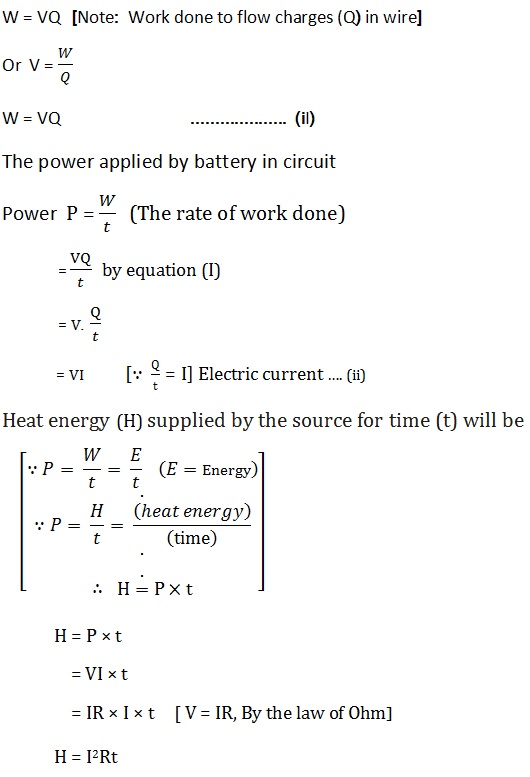
The law stated that the heat produced in a resistor is :
(i) Directly proportional to the square of current (I) for a given resistance.
(ii) Directly proportional to resistance (R) for a given current.
(iii) Directly proportional to the time for which the current flows through the resistor.
For students preparing for board exams or competitive assessments, CBSE notes have become an indispensable tool. These notes summarize the NCERT textbooks, highlighting key concepts, formulas, definitions, and diagrams in a concise and easy-to-understand format. Unlike lengthy textbooks, CBSE notes allow students to focus on the most important points, saving valuable time during revision.
In conclusion, CBSE notes are not just a revision tool—they are a strategy. When used correctly, they help students cover the syllabus efficiently, improve retention, and approach exams with confidence. For exam-going students, the combination of structured notes, practice, and consistent revision is the key to achieving top results.
Ace your exams with CBSE Notes for Class 10 Science chapter 12. Electricity: page 2 . These notes provide a clear explanation of important concepts, formulas, diagrams, and solved examples from the NCERT syllabus. Specially designed for Class 10 students, the notes are structured in a simple, point-wise manner to make revision quick and effective. Whether you are preparing for school tests, board exams, or competitive exams, these Science notes will boost your confidence and save valuable study time. You can also download Science class 10 chapter 12. Electricity free PDF notes for offline learning. With easy-to-grasp language, exam tips, and well-organized content, these CBSE Science notes on chapter 12. Electricity – page 2 are the perfect study companion for scoring high marks and mastering the subject.
CBSE class 10 Science notes are available completely free in PDF, and these all notes are quick revising materials that help you prepare for your upcoming board exams. Students can easily access CBSE notes pdf free download class 10 Science and get free CBSE notes class 10 Science notes designed strictly as per the latest NCERT syllabus. These Class 10 CBSE notes and Class 10 Science notes are short, simple, and to the point, making them perfect for last-minute revisions. You can also refer to NCERT book notes for class 10 that cover every chapter in an easy-to-understand manner. With these Quick revision notes Science class 10, you save time while covering all important formulas, definitions, and concepts.
Download worksheets and assignments for better practice and revision.