 Toppers Study Toppers Study Toppers Study
Get CBSE Notes for Class 10 Science – 12. Electricity: Introduction . Clear, exam-focused notes with key concepts, formulas & solved examples.
CBSE Notes for Class 10 Science chapter 12. Electricity: Introduction , quick revision notes for Class 10 Science chapter 12. Electricity Introduction , Chapter-wise CBSE Revision Notes, CBSE Notes PDF Free Download, CBSE One Liner Notes Class 10, Half Yearly Revision Notes, CBSE Revision Notes Class 10 Science
Get CBSE Notes for Class 10 Science Chapter 12. Electricity: Introduction prepared by experts as per the latest NCERT syllabus and CBSE exam pattern. These concise and easy-to-understand notes cover important definitions, formulas, diagrams, and key concepts from the chapter to help students in quick revision and effective exam preparation. Whether you are studying for school tests, board exams, or competitive exams, these notes provide a reliable study resource. Designed in simple language with point-wise explanations, they save time and enhance learning efficiency. Download free PDF notes, explore solved examples, and strengthen your understanding of [Topic Name] for scoring high marks. Perfect for Class 10 students who want clear, structured, and exam-oriented notes for CBSE Science.
12. Electricity
Frictional electricity: The electricity developed by rubbing or friction is called frictional electricity.
Electric charge: There are two types of electric charge,
1. Positive charge: Charge acquired by a glass rod when rubbed with silk is called positive charge.
2. Negative charge: Charge acquired by a ebonite rod when rubbed with wool is called negative charge.
Fundamental law of electrostatics:
Statics electricity: Statics electricity deals with the electric charges at rest.
Current electricity: current electricity deals with the electric charges in motion.
Electric Current And Charge:
When the electric charge flows through a conductor, we say that there is an electric current in the conductor.
In other words: An electric current is a flow of a electric charge.
Electric current is expressed by the amount of charge flowing through a particular area in unit time.
Flowing/moving of electrons:
The electrons are repelled by the negative charge at the negative terminal of the battery and attracted by the positive charge at the positive terminal. Therefore the electrons drift away from the negative terminal and toward the positive terminal. When electrons reach the positive terminal a chemical reaction transfers them across the battery and back to the negative terminal.
Conductor:
A substances which allows the passage of electric charge throught it easily, is called conductor. Example: copper, silver, aluminium etc.
Insulator: A substance which does not allow electric current to flow through it is called insulator. Example- rubber, plastic ebonite, glass etc.
Cunductivity: Conductivity is a property of conductor by which it allow the passage electric charge throught it.
Supercunductivity: Superconductivity is a phenomenon of exactly zero electrical resistance at very low temperature.
Coulomb's law: The force of attraction or repulsion between two point charges are directly proportional to the product (q1q2) of the two charges and inversely proportional to the square of the the distance(r) between them.
Mathematically,
F ∝ q1q2 ......................... (i)
F ∝ 1/ r2 ..........................(ii)
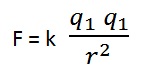
k is constant value, but the value of K depends on the nature of the medium between the two charges.
Charges in vacuum of K = 9 × 10⁹ Nm2/C2
Electric Circuit:
A continuous and closed path of an electric current is called an electric circuit.
The flow of the electricity:
Electrons constitute the flow of charge. electric current was considered to be the flow of positive charges and the direction of flow of positive charges was taken to be the direction of electric current.
If a net charge Q, flows across any cross-section of a conductor in
time t, then the current I, through the cross-section is;
I = Q/t
The SI unit of electric charge is coulomb (C), which is equivalent to the charge contained in nearly 6 × 10¹⁸ electrons.
Coulomb: It is the SI unit of charge, which is equivalent to the charge contained in nearly 6 × 10¹⁸ electrons.
Charge on an electron = -1.6 × 10⁻¹⁹ coulomb (C).
Charge on a proton = 1.6 × 10⁻¹⁹ coulomb (C).
Law of conservation of charge: Electric charges can neither be created nor destroyed, they can only be transferred from one body to another body.
Ampere: It is the SI unit of current. When one coulomb of charge flows in one second it is called one Ampere of current.
1A = 1C/1s;
The electric current flows in the circuit from the positive terminal of the cell to the negative terminal of the cell through the bulb and ammeter.
Ammeter: It is a device to measure electric current in a circuit. It is always connected in series in a circuit.
Galvanometer: It is a device to detect current in an electric circuit.
Conventional current: Conventionally, the direction of motion of positive charges is taken as the direction of current. The direction of conventional current is opposite to the flow of electron.
Direction in which an electric current is considered to flow in a circuit. By convention, the direction is that in which positive-charge carriers would flow - from the positive terminal of a cell to its negative terminal. It is opposite in direction to the flow of electrons.
Electrostatic potential:
Electrostatic potential at any point in an electric field is defined as the amount of work done in bringing a unit positive charge of one coulomb from infinity to that point. Its unit is volt.
Potential Difference:
The electrons move only if there is a difference of electric pressure, this difference in electric pressure is called the potential difference – along the conductor.
Potential difference between two points:
the electric potential difference between two points in an electric circuit carrying some current as the work done to move a unit charge from one point to the other.

Or

Voltmeter:
The potential difference is measured by means of an instrument called
the voltmeter.
One volt potential difference:
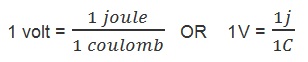
One volt is the potential difference between two points in a current carrying conductor when 1 joule of work is done to move a charge of 1 coulomb from one point to the other.
Connection of voltmeter:
The voltmeter is always connected in parallel across the points between which the potential difference is to be measured.
Cells Or Battery: It is a device which helps to maintain the potential difference between two points of conductor.
Electromotive force (EMF): It is a force applied by cell or battery to produce electric current through a wire.
The electric current flowing through a metallic wire is directly proportional to the potential difference V, across its ends provided its temperature remains the same. This is called Ohm’s law.
According to this law.
V ∝ I or V = RI
see this volt-current graph
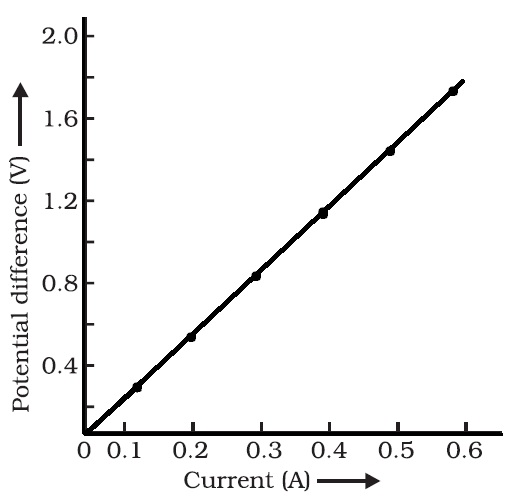
if potential difference is increased then electric current also increases.
And if potential difference is decreases then electric current also decreases.
Resistance:
It is the property of a conductor to resist the flow of charges through it.
Using ohm law:
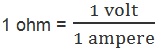
Resistance = Potential difference/Current

1 Ohm of resistance: if the potential difference across the two ends of a conductor is 1 V and the current through it is 1 A, then the resistance R, of the conductor is 1 Ω.
Variable resistance: A component used to regulate current without changing the voltage source is called variable resistance.
Rheostat: It is a device which is often used to change the resistance in the electric circuit.
Resistor: A conductor having some appreciable resistance is called a resistor.
Some points:
Good conductor: A component of a given size that offers a low
resistance is a good conductor.
Poor conductor: A component of identical size that offers a higher resistance is a poor conductor.
Resistance of a conductor depends on followings factors:
(i) On Length of conductor.
(ii) On Area of cross-section of conductor.
(iii) On the nature of conductor's materail.
Relation among Length, Area and Resistance:
Resistance of a uniform metallic conductor is directly proportional to its length (l) and inversely proportional to the area of cross-section (A).
This gives:
R ∝ l .................. (i)
and R ∝ l/A ................... (ii)
R ∝ l/A using (i) and (ii)
or,
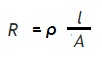
where ρ (rho) is a constant of proportionality and is called the electrical
resistivity of the material of the conductor.
The SI unit of resistivity is Ω m.
Resistivity: Resistivity is a characteristic property of the material. S. I unit of resistivity is ohm (Ω). It is denoted by p.
Charactristics of alloy:
(i) The resistivity of an alloy is generally higher than that of its constituent metals.
(ii) Alloys do not oxidise (burn) readily at high temperatures.
(iii) They have high melting point.
Therefore, alloys are commonly used in electrical heating devices, like electric iron, toasters etc. Tungsten is used almost exclusively for filaments of electric bulbs, whereas copper and aluminium are generally used for electrical transmission lines.
For students preparing for board exams or competitive assessments, CBSE notes have become an indispensable tool. These notes summarize the NCERT textbooks, highlighting key concepts, formulas, definitions, and diagrams in a concise and easy-to-understand format. Unlike lengthy textbooks, CBSE notes allow students to focus on the most important points, saving valuable time during revision.
In conclusion, CBSE notes are not just a revision tool—they are a strategy. When used correctly, they help students cover the syllabus efficiently, improve retention, and approach exams with confidence. For exam-going students, the combination of structured notes, practice, and consistent revision is the key to achieving top results.
Ace your exams with CBSE Notes for Class 10 Science chapter 12. Electricity: Introduction . These notes provide a clear explanation of important concepts, formulas, diagrams, and solved examples from the NCERT syllabus. Specially designed for Class 10 students, the notes are structured in a simple, point-wise manner to make revision quick and effective. Whether you are preparing for school tests, board exams, or competitive exams, these Science notes will boost your confidence and save valuable study time. You can also download Science class 10 chapter 12. Electricity free PDF notes for offline learning. With easy-to-grasp language, exam tips, and well-organized content, these CBSE Science notes on chapter 12. Electricity – Introduction are the perfect study companion for scoring high marks and mastering the subject.
CBSE class 10 Science notes are available completely free in PDF, and these all notes are quick revising materials that help you prepare for your upcoming board exams. Students can easily access CBSE notes pdf free download class 10 Science and get free CBSE notes class 10 Science notes designed strictly as per the latest NCERT syllabus. These Class 10 CBSE notes and Class 10 Science notes are short, simple, and to the point, making them perfect for last-minute revisions. You can also refer to NCERT book notes for class 10 that cover every chapter in an easy-to-understand manner. With these Quick revision notes Science class 10, you save time while covering all important formulas, definitions, and concepts.
Download worksheets and assignments for better practice and revision.