 Toppers Study Toppers Study Toppers Study
Detailed NCERT Solutions for 9 Mathematics 12. Herons Formula to simplify learning. Understand chapters clearly and practice with free solutions for better results.

Detailed NCERT Solutions for 9 Mathematics 12. Herons Formula to simplify learning. Understand chapters clearly and practice with free solutions for better results.
Preparing for exams becomes easier with Exercise 12.2. Whether you are studying for board exams or mid-term exams, 9 Mathematics Chapter 12. Herons Formula solutions provide quick revising points, well-structured answers, and additional practice material to help you score better.
ncert_solutionsQ1: A park, in the shape of a quadrilateral ABCD, has ∠ C = 90º, AB = 9 m, BC = 12 m, CD = 5 m and AD = 8 m. How much area does it occupy?
Solution: Let us join BD. 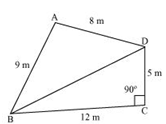
In ΔBCD, applying Pythagoras theorem,
BD2 = BC2 + CD2
= (12)2 + (5)2
= 144 + 25
BD2 = 169
BD = 13 m
Area of ΔBCD
For ΔABD,
By Heron's formula,
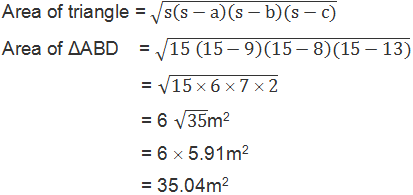
Area of Quadrilateral = Area of ΔABD + Area of ΔBCD
= 30m2+ 35.04m2
= 65.04m2
Q2: Find the area of a quadrilateral ABCD in which AB = 3 cm, BC = 4 cm, CD = 4 cm, DA = 5 cm and AC = 5 cm.
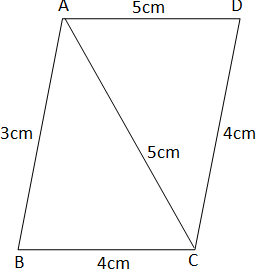
Solution:
In ΔABC
AB = 3cm, BC = 4cm, AC = 5cm
Area of ΔABC
For ΔADC,
Perimeter = 2s = AC + CD + DA = (5 + 4 + 5) cm = 14 cm
s = 7 cm
By Heron's formula,

Area of ABCD = Area of ΔABC + Area of ΔADC
= 6 + 9.166
= 15.166 = 15.2cm2
Q3: Radha made a picture of an aero plane with colored papers as shown in the given figure. Find the total area of the paper used.
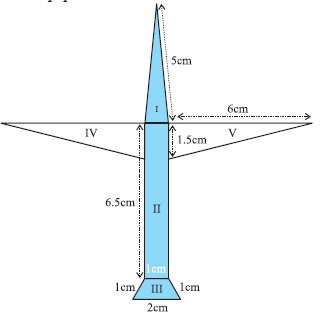
Solution:
For triangle I
This triangle is an isosceles triangle.
Perimeter = 2s = (5 + 5 + 1) cm = 11cm
S = = 5.5cm
Area of the triangle
For quadrilateral II
This quadrilateral is a rectangle.
Area = l × b = (6.5 × 1) cm2 = 6.5 cm2
For quadrilateral III
This quadrilateral is a trapezium.
Perpendicular height of parallelogram
Area = Area of parallelogram + Area of equilateral triangle
= 0.866 + 0.433 = 1.299 cm2

Area of triangle (IV) = Area of triangle in (V)
Total area of the paper used = 2.488 + 6.5 + 1.299 + 4.5 × 2
= 19.287 cm2
Q4: A triangle and a parallelogram have the same base and the same area. If the sides of the triangle are 26 cm, 28 cm and 30 cm, and the parallelogram stands on the base 28 cm, find the height of the parallelogram.
Solution:
Here, Sides of triangle be A, B, C.
A = 26cm, b = 28cm, c = 30
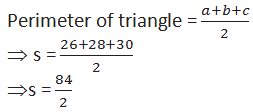
⇒ s = 42cm
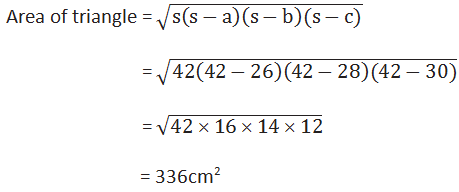
Area of parallelogram = Area of triangle
28cm × h = 336 cm2
h = 336/28 cm
h = 12 cm
The height of the parallelogram is 12 cm.
Q5: A rhombus shaped field has green grass for 18 cows to graze. If each
side of the rhombus is 30 m and its longer diagonal is 48 m, how much
area of grass field will each cow be getting?
Solution:
Diagonal AC divides the rhombus ABCD into two congruent triangles of
equal area.
Semi perimeter of ΔABC = (30 + 30 + 48)/2 m = 54 m
Using heron's formula,
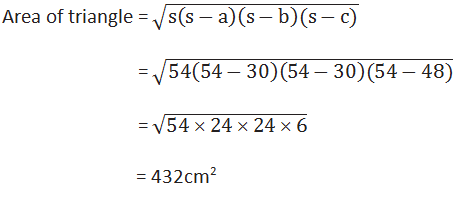
Area of field = 2 × area of the ΔABC = (2 × 432)m2 = 864 m2
Thus,
Area of grass field which each cow will be getting = 864/18 m2 = 48 m2
Q6: An umbrella is made by stitching 10 triangular pieces of cloth of two Different colors (see Fig.12.16), each piece measuring 20 cm, 50 cm and 50 cm. How much cloth of each color is required for the umbrella?
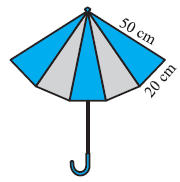
Solution: Semi perimeter of each triangular piece 
=120/2 cm = 60cm
Using heron's formula,
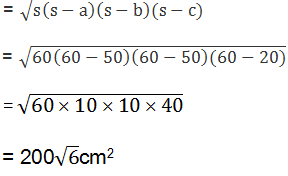
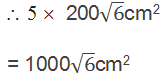
Area of the triangular piece
There are 5 colors in umbrella.
Q7: A kite in the shape of a square with a diagonal 32 cm and an isosceles triangle of base 8 cm and sides 6 cm each is to be made of three different shades as shown in Fig. 12.17. How much paper of each shade has been used in it?
Solution: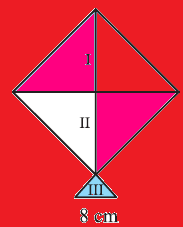
As the diagonal of the square bisect each other at right angle.
Area of given kite = ½ (diagonal) 2
= ½ × 32 × 32 = 512 cm2
Area of shade I = Area of shade II
512/2cm2 = 256 cm2
So, area of paper required in each shade = 256 cm2
For the III section,
Length of the sides of triangle = 6cm, 6cm and 8cm
Semi perimeter of triangle = (6 + 6 + 8)/2 cm = 10cm
Using heron's formula,

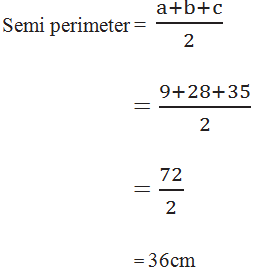
Q8: A floral design on a floor is made up of 16 tiles which are triangular, the sides of the triangle being 9 cm, 28 cm and 35 cm (see Fig. 12.18). Find the cost of polishing the tiles at the rate of 50p per cm2.
Solution:
Here a = 9cm
b = 28cm 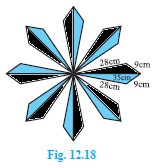
c = 35cm
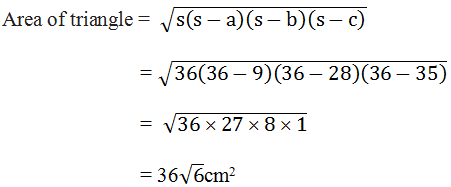
= 36 ´ 2.45
= 88.2cm2
Area of 16 tiles = 16 ´ 88.2
= 1411.2cm2
Cost of polishing the tiles at the rate of 50p per cm2.
= 1411.2cm2 ´ 0.50
= Rs705.60
9. A field is in the shape of a trapezium whose parallel sides are 25 m and10 m. The non-parallel sides are 14 m and 13 m. find the area of the field.
Solution: Let ABCD be the given trapezium with parallel sides AB = 25m and CD = 10m and the non-parallel sides AD = 13m and BC = 14m.
CM ⊥ AB and CE || AD.
In ΔBCE,
BC = 14m, CE = AD = 13 m and
BE = AB - AE = 25 - 10 = 15m
Semi perimeter of the ΔBCE = (15 + 13 + 14)/2 m = 21 m

= 84m2
Also, area of the ΔBCE = 1/2 × BE × CM = 84 m2
⇒ 1/2 × 15 × CM = 84 m2
⇒ CM = 168/15 m2
⇒ CM = 56/5 m2
Area of the parallelogram AECD = Base × Altitude
= AE × CM
= 10 × 84/5
= 112 m2
Area of the trapezium ABCD = Area of AECD + Area of ΔBCE
= (112+ 84) m2
= 196 m2
Exercise 12.2 are created by experts to give step-by-step explanations. Around 60–70% of exam questions are based on NCERT concepts. Our 9 Mathematics Chapter 12. Herons Formula solutions help you understand the core concepts and practice effectively.
Revision is the key to exam success. Our notes for 9 Mathematics highlight important formulas, key definitions, and exam-ready points from Chapter 12. Herons Formula. These quick revision notes make last-minute preparation easy.
Every NCERT chapter ends with exercises, and solving them is crucial. Our Exercise 12.2 include complete solutions for 9 Mathematics Chapter 12. Herons Formula exercises. With step-by-step answers, you gain clarity and confidence to attempt similar exam questions.
To boost your preparation, we also provide additional important questions with answers. These are prepared from previous year board papers, sample papers, and important concepts of Chapter 12. Herons Formula. Practicing these ensures you are well-prepared for both board and mid-term exams.
Our Exercise 12.2 are useful for both board exams and mid-term exams. For 9 Mathematics, we provide notes, exercises, and important Q&A so that you can revise smartly and write perfect answers in exams.
In short, Exercise 12.2 for 9 Mathematics Chapter 12. Herons Formula are a complete study package. With quick revising points, NCERT exercises, and additional important questions, you can prepare effectively for exams. Make these solutions your study companion and excel in your academic journey.
Go to other Class
Download worksheets and assignments for better practice and revision.