 Toppers Study Toppers Study Toppers Study
Detailed NCERT Solutions for 9 Mathematics 7. Triangles to simplify learning. Understand chapters clearly and practice with free solutions for better results.

Detailed NCERT Solutions for 9 Mathematics 7. Triangles to simplify learning. Understand chapters clearly and practice with free solutions for better results.
Preparing for exams becomes easier with Exercise 7.2. Whether you are studying for board exams or mid-term exams, 9 Mathematics Chapter 7. Triangles solutions provide quick revising points, well-structured answers, and additional practice material to help you score better.
ncert_solutionsChapter 7. Triangles
Exercise 7.2
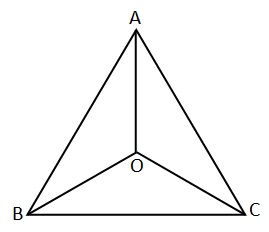
Q1. In an isosceles triangle ABC, with AB = AC, the bisectors of ∠ B and ∠ C intersect each other at O. Join A to O. Show that :
(i) OB = OC (ii) AO bisects ∠ A
Solution:
Given: In an isosceles triangle ABC, with AB = AC, the bisectors of ∠ B and ∠ C intersect each other at O.
To prove:
(i) OB = OC
(ii) AO bisects ∠ A
Proof: In ΔABC, We have:
AB = AC
∠ B = ∠ C [ opposite angle to the equal side ]
Or 1/2 ∠ B = 1/2 ∠C
So, ∠OBC = ∠OCB […1]
In D ABO and D ACO
AB = AC [given]
∠OBC = ∠OCB [from …1]
AO = AO [common]
By SAS Congruence Criterion Rule
DABO ≅ DACO
OB = OC [ By CPCT ]
∠BAO = ∠CAO [ By CPCT ]
AO bisect ∠A.
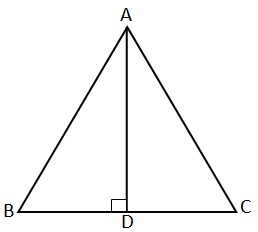
Q2. In Δ ABC, AD is the perpendicular bisector of BC (see Fig. 7.30). Show that Δ ABC is an isosceles triangle in which AB = AC.
Solution:
Given: In Δ ABC, AD is the perpendicular bisector of BC.
To prove: Δ ABC is an isosceles triangle in which AB = AC.
Proof: In Δ ABD and Δ ACD, we have
DB = DC [since D bisect BC]
∠ BDC = ∠ADC [AD is the perpendicular bisector of BC].
AD = AD [common]
By SAS Congruence Criterion Rule
Δ ABD ≅ Δ ACD
AB =AC [CPCT]
Hence, Δ ABC is an isosceles triangle
Q3. ABC is an isosceles triangle in which altitudes BE and CF are drawn to equal sides AC and AB respectively (see Fig. 7.31). Show that these altitudes are equal.
Solution:
Given: ABC is an isosceles triangle in which BE ⊥ AC and CF ⊥ AB where AB = AC.
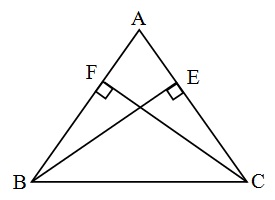
To prove: BE = CF.
Proof: Here, BE ⊥ AC and CF ⊥ AB (Given)
In ΔABE and Δ ACF
∠ AEB = ∠ AFC (90० Each)
∠ A = ∠ A (Common)
AB = AC (Given)
By ASA Congruency Criterion Rule
ΔABE ≅ Δ ACF
BE = CF [ By CPCT ]
Q4. ABC is a triangle in which altitudes BE and CF to sides AC and AB are equal (see Fig. 7.32). Show that
(i) Δ ABE ≅ Δ ACF
(ii) AB = AC, i.e., ABC is an isosceles triangle.
Solution:
Given: ABC is a triangle in which
BE ⊥ AC and CF ⊥ AB and BE = CF
To Prove :
(i) Δ ABE ≅ Δ ACF
(ii) AB = AC, i.e., ABC is an isosceles triangle.
Proof :
(i) In Δ ABE and Δ ACF
BE = CF (Given)
∠ AEB = ∠ AFC (90० Each)
∠ A = ∠ A (Common)
Using ASA Congruency Property
Δ ABE ≅ Δ ACF Proved I
(ii) AB = AC [By CPCT]
Therefore, ABC is an isosceles triangle.
Q5. ABC and DBC are two isosceles triangles on the same base BC (see Fig. 7.33). Show that ∠ ABD = ∠ ACD.
Solution:
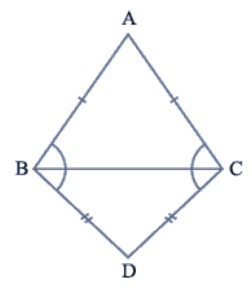 Given : ABC and DBC are two isosceles triangles on the same base BC.
To prove : ∠ ABD = ∠ ACD
Proof : ABC is an isosceles triangle in which
AB = AC (Given)
∴ ∠ ABC = ∠ ACB .......... (1)
(Opposite angles of equal sides)
Similarily,
BCD is also an isosceles triangle.
BD = CD (Given)
∴ ∠ DBC = ∠ DCB .......... (2)
(Opposite angles of equal sides)
Adding Equation (1) and (2)
∠ ABC + ∠ DBC = ∠ ACB + ∠ DCB
Or, ∠ ABD = ∠ ACD Proved
Q6. ΔABC is an isosceles triangle in which AB = AC. Side BA is produced to D such that AD = AB (see Fig. 7.34). Show that ∠ BCD is a right angle.
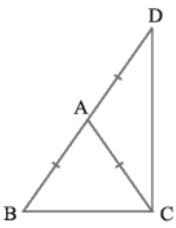
Solution :
Given: ΔABC is an isosceles triangle in which AB = AC.
Side BA is produced to D such that AD = AB
To prove : ∠ BCD = 90०
Proof :
AB = AC .............. (1) (Given)
And, AB = AD .............. (2) (Given) 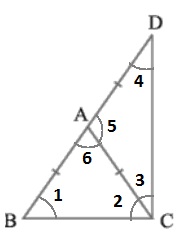
From equation (1) and (2) we have
AC = AD ...............(3)
∴ ∠3 = ∠4 .... (4) (Opposite angles of equal sides)
Now, AB = AC from (1)
∴ ∠1 = ∠2 .... (5) (Opposite angles of equal sides)
In ΔABC,
Exterior ∠5 = ∠1 + ∠2
Or, ∠5 = ∠2 + ∠2 from (5)
Or, ∠5 = 2∠2 ....... (6)
Similarily,
Exterior ∠6 = ∠3 + ∠4
Or, ∠6 = 2∠3 from (7)
Adding equation (6) and (7)
∠5 + ∠6 = 2∠2 + 2∠3
∠5 + ∠6 = 2(∠2 + ∠3)
Or, 180० = 2(∠2 + ∠3) [ ∵ ∠BAC + ∠DAC = 180० ]
Or, ∠2 + ∠3 = 180० / 2
Or, ∠BCD = 90० Proved
Q7. ABC is a right angled triangle in which ∠ A = 90° and AB = AC. Find ∠ B and ∠ C.
Solution:
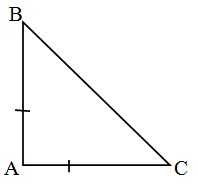 Given : ABC is a right angled triangle in which
∠ A = 90° and AB = AC.
To Find : ∠B and ∠C
AB = AC (Given)
∴ ∠B = ∠C ............(1)
(Opposite angles of equal sides)
In triangle ABC,
∠A + ∠B + ∠C = 180० (Angle sum property)
90° + ∠B + ∠B = 180० Using equation (1)
2 ∠B = 180० - 90°
2 ∠B = 90°
∠B = 90°/ 2
∠B = 45°
∴ ∠B = 45° and ∠C = 45°
Q8. Show that the angles of an equilateral triangle are 60° each. ⊥
Solution:
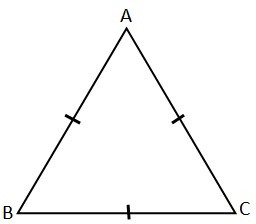 Given: ABC is a equilateral triangle, in which
AB = BC = AC
To Prove :
∠A = ∠B = ∠C = 60°
Proof :
AB = AC (Given)
∠B = ∠C ....................... (1) [opposite angle of equal sides]
AB = BC (Given)
∠A = ∠C ....................... (2) [opposite angle of equal sides]
AC = BC (Given)
∠A = ∠B ....................... (3) [opposite angle of equal sides]
From equation (1), (2) and (3) we have
∠A = ∠B = ∠C .............. (4)
In triangle ABC
∠A + ∠B + ∠C = 180°
∠A + ∠A + ∠A = 180°
3 ∠A = 180°
∠A = 180°/3
∠A = 60°
∴ ∠A = ∠B = ∠C = 60°
Exercise 7.2 are created by experts to give step-by-step explanations. Around 60–70% of exam questions are based on NCERT concepts. Our 9 Mathematics Chapter 7. Triangles solutions help you understand the core concepts and practice effectively.
Revision is the key to exam success. Our notes for 9 Mathematics highlight important formulas, key definitions, and exam-ready points from Chapter 7. Triangles. These quick revision notes make last-minute preparation easy.
Every NCERT chapter ends with exercises, and solving them is crucial. Our Exercise 7.2 include complete solutions for 9 Mathematics Chapter 7. Triangles exercises. With step-by-step answers, you gain clarity and confidence to attempt similar exam questions.
To boost your preparation, we also provide additional important questions with answers. These are prepared from previous year board papers, sample papers, and important concepts of Chapter 7. Triangles. Practicing these ensures you are well-prepared for both board and mid-term exams.
Our Exercise 7.2 are useful for both board exams and mid-term exams. For 9 Mathematics, we provide notes, exercises, and important Q&A so that you can revise smartly and write perfect answers in exams.
In short, Exercise 7.2 for 9 Mathematics Chapter 7. Triangles are a complete study package. With quick revising points, NCERT exercises, and additional important questions, you can prepare effectively for exams. Make these solutions your study companion and excel in your academic journey.
Go to other Class
Download worksheets and assignments for better practice and revision.