 Toppers Study Toppers Study Toppers Study
Detailed NCERT Solutions for 9 Mathematics 5. Introduction To Euclid’s Geometry to simplify learning. Understand chapters clearly and practice with free solutions for better results.

Detailed NCERT Solutions for 9 Mathematics 5. Introduction To Euclid’s Geometry to simplify learning. Understand chapters clearly and practice with free solutions for better results.
Preparing for exams becomes easier with Exercise 5.1. Whether you are studying for board exams or mid-term exams, 9 Mathematics Chapter 5. Introduction To Euclid’s Geometry solutions provide quick revising points, well-structured answers, and additional practice material to help you score better.
ncert_solutionsChapter 5. ntroduction to euclid 's geometry
Excercise : 5.1
1. Which of the following statements are true and which are false? Give reasons for your answers.
(i) Only one line can pass through a single point.
(ii) There are an infinite number of lines which pass through two distinct points.
(iii) A terminated line can be produced indefinitely on both the sides.
(iv) If two circles are equal, then their radii are equal.
(v) In Fig. 5.9, if AB = PQ and PQ = XY, then AB = XY

Solution :
(i) false, infinite lines can pass through a point.
(ii) false, only single line can pass through two distinct point.
(iii) true, they can be produced both sides indefinitely.
(iv) true, all the circles are drawn from radius.
(v) true, all three lines are equal to each other.
2. Give a definition for each of the following terms. Are there other terms that need to be defined first? What are they, and how might you define them?
(i) parallel lines
(ii) perpendicular lines
(iii) line segment
(iv) radius of a circle
(v) square
Solution :
(i) the two lines never meet each other and distance between them are equal.
(ii) the two lines stand on each other such that the angle between them is a right angle .
(iii) the lines which has two point.
(iv) the distance between centre and circumference.
(v) the closed figure which has all sides equal.
3. Consider two ‘postulates’ given below:
(i) Given any two distinct points A and B, there exists a third point C which is in between A and B.
(ii) There exist at least three points that are not on the same line.
Do these postulates contain any undefined terms? Are these postulates consistent? Do they follow from Euclid’s postulates? Explain.
Solution :
Yes, this postulate contain two undefined terms that lines and point.
Yes, this postulates are inconsistent because they deal with two different situation and none of them follow the euclid’s postulate because it is based on axiom .
4. If a point C lies between two points A and B such that AC = BC, then prove that AC = AB. Explain by drawing the figure.
Solution :
Given : AC = BC 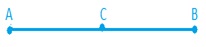
To prove : AC = AB
Proof : AC +BC = AB
or AC + AC = AB
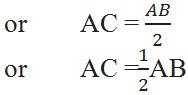
or 2AC = AB
5. In Question 4, point C is called a mid-point of line segment AB. Prove that every line segment has one and only one mid-point.
Solution :
C is the mid-point of AB
So, AC = BC
Let, C` is a point on AB. Which is the mid-point of AB
So, AC` = BC`
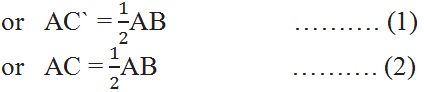
By eq (1) and (2)
AC`= AC
or C`= C
So, C and C` is same mid-point mean it is coincident.
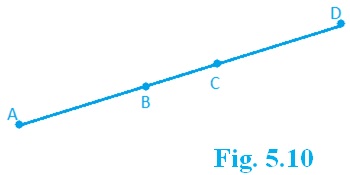
6. In Fig. 5.10, if AC = BD, then prove that AB = CD.
Solution:
Given: AC = BD
To prove: AB = CD
Proof: AC = BD ……… (1)
Subtracting BC from eq (1)
AC – BC = BD – BC
AB = CD
7. Why is Axiom 5, in the list of Euclid’s axioms, considered a ‘universal truth’? (Note that the question is not about the fifth postulate.)
Solution :
This is true in anything in any part of the world therefore, it is universal.
Exercise 5.1 are created by experts to give step-by-step explanations. Around 60–70% of exam questions are based on NCERT concepts. Our 9 Mathematics Chapter 5. Introduction To Euclid’s Geometry solutions help you understand the core concepts and practice effectively.
Revision is the key to exam success. Our notes for 9 Mathematics highlight important formulas, key definitions, and exam-ready points from Chapter 5. Introduction To Euclid’s Geometry. These quick revision notes make last-minute preparation easy.
Every NCERT chapter ends with exercises, and solving them is crucial. Our Exercise 5.1 include complete solutions for 9 Mathematics Chapter 5. Introduction To Euclid’s Geometry exercises. With step-by-step answers, you gain clarity and confidence to attempt similar exam questions.
To boost your preparation, we also provide additional important questions with answers. These are prepared from previous year board papers, sample papers, and important concepts of Chapter 5. Introduction To Euclid’s Geometry. Practicing these ensures you are well-prepared for both board and mid-term exams.
Our Exercise 5.1 are useful for both board exams and mid-term exams. For 9 Mathematics, we provide notes, exercises, and important Q&A so that you can revise smartly and write perfect answers in exams.
In short, Exercise 5.1 for 9 Mathematics Chapter 5. Introduction To Euclid’s Geometry are a complete study package. With quick revising points, NCERT exercises, and additional important questions, you can prepare effectively for exams. Make these solutions your study companion and excel in your academic journey.
Go to other Class
Download worksheets and assignments for better practice and revision.