 Toppers Study Toppers Study Toppers Study
Get complete NCERT Solutions for 7 Science 16. Water : A Precious Resource with detailed explanations. Easy-to-understand answers to help students study effectively and score better.
Get complete NCERT Solutions for 7 Science 16. Water : A Precious Resource with detailed explanations. Easy-to-understand answers to help students study effectively and score better.
Preparing for exams becomes easier with NCERT Exercise . Whether you are studying for board exams or mid-term exams, 7 Science Chapter 16. Water : A Precious Resource solutions provide quick revising points, well-structured answers, and additional practice material to help you score better.
ncert_solutionsExercise
1. Mark ‘T’ if the statement is true and ‘F’ if it is false:
(a) The freshwater stored in the ground is much more than that present in the rivers and lakes of the world. (T/F)
(b) Water shortage is a problem faced only by people living in rural areas. (T/F)
(c) Water from rivers is the only source for irrigation in the fields. (T/F)
(d) Rain is the ultimate source of water. (T/F)
Answer:
(a) T (b) F (c) F (d) T
2. Explain how groundwater is recharged?
Answer:
The rain water and water from other sources such as river and ponds seeps through the soil and fills the empty spaces and cracks deep below the ground. The process of seeping of water into the ground is called infiltration. The groundwater thus gets recharged by this process.
3. There are ten tubewells in a lane of fifty houses. What could be the long term impact on the water table?
Answer:
The water table will be depleted. Atime will come when table fall below the pipe of tubewells. Water will not be fetched by these any more.
4. You have been asked to maintain a garden. How will you minimise the use of water?
Answer:
(i) By collecting rain water.
(ii)By using water after bath or washing utensils for watering in the garden.
5. Explain the factors responsible for the depletion of water lable.
Answer:
(i) Increasing population: Increasing population creates demand for construction of houses, shops, offices, roads and pavements. This decrease the open areas likeparks, and playground.
(ii) Increasing industries: Water is used by all the industries. The number of industries is increasing continously. Water used by most of the industries is drawn from the ground
(iii) Agriculture activities: These irrigation system may suffer from lack of water due to erractic rainfall. Therefore, farmers have to use groundwater for irrigation.
6. Fill in the blanks with the appropriate answers:
(a) People obtain groundwater through________ and ________.
(b) Three forms of water are ________, ________ and ________.
(c) The water bearing layer of the earth is ________.
(d) The process of water seepage into the ground is called ________.
Answer:
(a) well and hand pumps (b) solid, liquid and gas (c) acquifer (d) infirltration.
7. Which one of the following is not responsbile for water shortage?
(i) Rapid growth of industries
(ii) Increasing population
(iii) Heavy rainfall
(iv) Mismanagement of water resources
Answer:
(iii) Heavy rainfall.
8. Choose the correct opton.
The total water
(i) in the lakes and rivers of the world remains constant.
(ii) under the ground remains constant.
(iii) in the seas and oceans of the world remains constant.
(iv) of the world remains constant.
Answer:
(iv) Of the world remains constant.
9. Make a sketch showing groundwater and water table. Label it.
Answer-
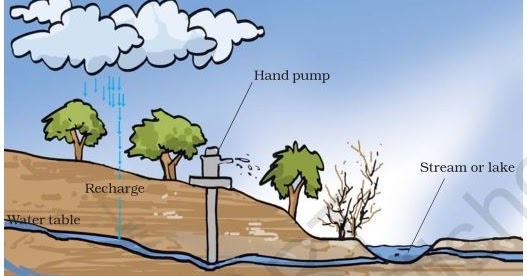
Groundwater and Water lable
NCERT Exercise are created by experts to give step-by-step explanations. Around 60–70% of exam questions are based on NCERT concepts. Our 7 Science Chapter 16. Water : A Precious Resource solutions help you understand the core concepts and practice effectively.
Revision is the key to exam success. Our notes for 7 Science highlight important formulas, key definitions, and exam-ready points from Chapter 16. Water : A Precious Resource. These quick revision notes make last-minute preparation easy.
Every NCERT chapter ends with exercises, and solving them is crucial. Our NCERT Exercise include complete solutions for 7 Science Chapter 16. Water : A Precious Resource exercises. With step-by-step answers, you gain clarity and confidence to attempt similar exam questions.
To boost your preparation, we also provide additional important questions with answers. These are prepared from previous year board papers, sample papers, and important concepts of Chapter 16. Water : A Precious Resource. Practicing these ensures you are well-prepared for both board and mid-term exams.
Our NCERT Exercise are useful for both board exams and mid-term exams. For 7 Science, we provide notes, exercises, and important Q&A so that you can revise smartly and write perfect answers in exams.
In short, NCERT Exercise for 7 Science Chapter 16. Water : A Precious Resource are a complete study package. With quick revising points, NCERT exercises, and additional important questions, you can prepare effectively for exams. Make these solutions your study companion and excel in your academic journey.
Go to other Class
Download worksheets and assignments for better practice and revision.