 Toppers Study Toppers Study Toppers Study
Get complete NCERT Solutions for 7 Science 15. Light with detailed explanations. Easy-to-understand answers to help students study effectively and score better.
Get complete NCERT Solutions for 7 Science 15. Light with detailed explanations. Easy-to-understand answers to help students study effectively and score better.
Preparing for exams becomes easier with NCERT Exercise . Whether you are studying for board exams or mid-term exams, 7 Science Chapter 15. Light solutions provide quick revising points, well-structured answers, and additional practice material to help you score better.
ncert_solutionsQ1. Fill in the blanks:
(a) An image that cannot be obtained on a screen is called ____________.
(b) Image formed by a convex __________ is always virtual and smaller in size.
(c) An image formed by a __________ mirror is always of the same size as that of the object.
(d) An image which can be obtained on a screen is called a _________ image.
(e) An image formed by a concave ___________ cannot be obtained on a screen.
Answer:
(i) Vertual image
(ii) miror
(iii) plane
(iv) real
(v) lens
Q2. Mark ‘T’ if the statement is true and ‘F’ if it is false:
(a) We can obtain an enlarged and erect image by a convex mirror. (T/F)
(b) A concave lens always form a virtual image. (T/F)
(c) We can obtain a real, enlarged and inverted image by a concave mirror. (T/F)
(d) A real image cannot be obtained on a screen. (T/F)
(e) A concave mirror always form a real image. (T/F)
Answer:
(a) False
(b) True
(c) True
(d) False
(e) False
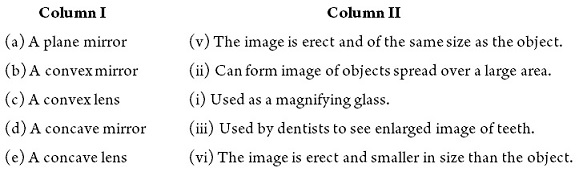
Q3. Match the items given in Column I with one or more items of Column II.
Column I Column II
(a) A plane mirror (i) Used as a magnifying glass.
(b) A convex mirror (ii) Can form image of objects spread over a large area.
(c) A convex lens (iii) Used by dentists to see enlarged image of teeth.
(d) A concave mirror (iv) The image is always inverted and magnified.
(e) A concave lens (v) The image is erect and of the same size as the object.
(vi) The image is erect and smaller in size than the object.
Answer:
Q4. State the characteristics of the image formed by a plane mirror.
Answer:
Characteristics of the image formed by a plane mirror are as follows:
(i) Images are virtual and erect.
(ii) it's position is behind the mirror.
(iii) Size of image is equal to size of object.
(iv) Laterally inverted image (image of left side visible on right side).
(v) Distance of image behind the mirror is equal to distance of object in front of mirror.
Q5. Find out the letters of English alphabet or any other language known to you in which the image formed in a plane mirror appears exactly like the letter itself. Discuss your findings.
Answer:
The letters are A, H, I, M, O, T, U, V, W and X which form same image as the letter is. These letters are laterally symmetrical.
Q6. What is a virtual image? Give one situation where a virtual image is formed.
Answer: The image, which cannot be obtained on a screen, is called virtual image. The images formed by plane mirror, convex mirror and concave lens are always virtual in nature.
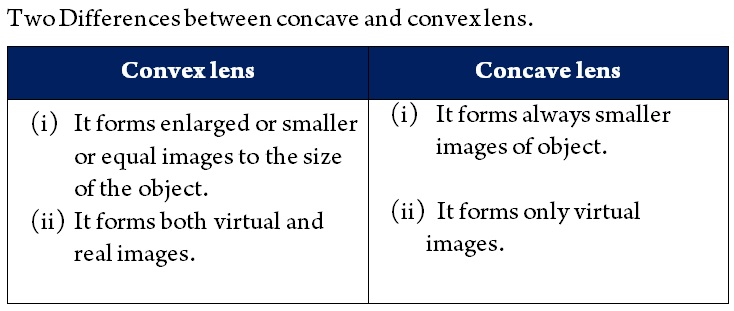
Q7. State two differences between a convex and a concave lens.
Answer:
Q8. Give one use each of a concave and a convex mirror.
Answer:
(i) Concave mirror is used by dentist, headlights in vehicle, As reflector in a torch, etc.
(ii) Convex mirror is used in rear view mirrors.
Q9. Which type of mirror can form a real image?
Answer: Cocave Mirror forms a real image.
Q10. Which type of lens forms always a virtual image? Choose the correct option in questions 11–13
Answer:
Concave lens.
Q11. A virtual image larger than the object can be produced by a
(i) concave lens (ii) concave mirror (iii) convex mirror (iv) plane mirror
Answer: (ii) Concave mirror
Q12. David is observing his image in a plane mirror. The distance between the mirror and his image is 4 m. If he moves 1 m towards the mirror, then the distance between David and his image will be
(i) 3 m (ii) 5 m (iii) 6 m (iv) 8 m
Answer: (iii) 6 m
Q13. The rear view mirror of a car is a plane mirror. A driver is reversing his car at a speed of 2 m/s. The driver sees in his rear view mirror the image of a truck parked behind his car. The speed at which the image of the truck appears to approach the driver will be
(i) 1 m/s (ii) 2 m/s (iii) 4 m/s (iv) 8 m/s
Answer: (ii) 2 m/s
NCERT Exercise are created by experts to give step-by-step explanations. Around 60–70% of exam questions are based on NCERT concepts. Our 7 Science Chapter 15. Light solutions help you understand the core concepts and practice effectively.
Revision is the key to exam success. Our notes for 7 Science highlight important formulas, key definitions, and exam-ready points from Chapter 15. Light. These quick revision notes make last-minute preparation easy.
Every NCERT chapter ends with exercises, and solving them is crucial. Our NCERT Exercise include complete solutions for 7 Science Chapter 15. Light exercises. With step-by-step answers, you gain clarity and confidence to attempt similar exam questions.
To boost your preparation, we also provide additional important questions with answers. These are prepared from previous year board papers, sample papers, and important concepts of Chapter 15. Light. Practicing these ensures you are well-prepared for both board and mid-term exams.
Our NCERT Exercise are useful for both board exams and mid-term exams. For 7 Science, we provide notes, exercises, and important Q&A so that you can revise smartly and write perfect answers in exams.
In short, NCERT Exercise for 7 Science Chapter 15. Light are a complete study package. With quick revising points, NCERT exercises, and additional important questions, you can prepare effectively for exams. Make these solutions your study companion and excel in your academic journey.
Go to other Class
Download worksheets and assignments for better practice and revision.