 Toppers Study Toppers Study Toppers Study
Get complete NCERT Solutions for 6 Science 10. MOTION AND MEASUREMENT OF DISTANCES with detailed explanations. Easy-to-understand answers to help students study effectively and score better.
Get complete NCERT Solutions for 6 Science 10. MOTION AND MEASUREMENT OF DISTANCES with detailed explanations. Easy-to-understand answers to help students study effectively and score better.
Preparing for exams becomes easier with Exercise (NCERT Text Book). Whether you are studying for board exams or mid-term exams, 6 Science Chapter 10. MOTION AND MEASUREMENT OF DISTANCES solutions provide quick revising points, well-structured answers, and additional practice material to help you score better.
ncert_solutions
Q1. Give two examples each, of modes of transport used on land, water and air.
Ans: Two examples of each.
Land transport: bus and train.
Water transport: boat and ship.
Air transport: Helicopter and aeroplane.
Q2. Fill in the blanks:
(i) One metre is ______________ cm.
(ii) Five kilometre is ______________ m.
(iii)Motion of a child on a swing is ______________.
(iv) Motion of the needle of a sewing machine is ______________.
(v) Motion of wheel of a bicycle is______________.
Ans:
(i) 100
(ii) 500
(iii) periodic motion
(iv) periodic motion
(v) rotational motion
Q3. Why can a pace or a footstep not be used as a standard unit of length?
Ans: Standarrd unit of length must have a fixed numeric value while footstep does have so.
Q4. Arrange the following lengths in their increasing magnitude:
1 metre, 1 centimetre, 1 kilometre,1 millimetre.
Ans: 1 milimetre, 1 centimetre, 1 metre, 1 kilometre
Q5. The height of a person is 1.65 m. Express it into cm and mm.
Ans:
The height of a person = 1.65 m
In centimetre,
1 metre = 100 cm
1.65 m = 1.65 x 100 cm
= 165 cm
In milimetre,
1 centimetre = 10 milimetre
1 metre = 100 centimetre
Or = 100 x 10 milimetre
= 1000 milimetre
1.65 metre = 1.65 x 1000 milimetre
= 1650 milimetre
Q6. The distance between Radha's home and her school is 3250 m. Express this distance into km.
Ans:
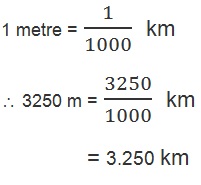
Q7. While measuring the length of a knitting needle, the reading of the scale at one end is 3.0 cm and at the other end is 33.1 cm. What is the length of the needle?
Ans:
Reading of scale at one end = 3.0 cm
Reading of scale at other end = 33.1 cm
Distance between two end = 33.1 - 3.0 cm
= 30.1 cm
Q8. Write the similarities and differences between the motion of a bicycle and a
ceiling fan that has been switched on.
Ans:
Similarities: the motion of a bicycle and a celing fan both have circular motion.
Differences: The bicycle moves on straight line but ceiling fan does not move so.
Q9. Why could you not use an elastic measuring tape to measure distance? What would be some of the problems you would meet in telling someone about a distance you measured with an elastic tape?
Ans:
Q10. Give two examples of periodic motion.
Ans:
(i) The motion of child on a swing.
(ii) moving here and there the branches of tree.
Exercise (NCERT Text Book) are created by experts to give step-by-step explanations. Around 60–70% of exam questions are based on NCERT concepts. Our 6 Science Chapter 10. MOTION AND MEASUREMENT OF DISTANCES solutions help you understand the core concepts and practice effectively.
Revision is the key to exam success. Our notes for 6 Science highlight important formulas, key definitions, and exam-ready points from Chapter 10. MOTION AND MEASUREMENT OF DISTANCES. These quick revision notes make last-minute preparation easy.
Every NCERT chapter ends with exercises, and solving them is crucial. Our Exercise (NCERT Text Book) include complete solutions for 6 Science Chapter 10. MOTION AND MEASUREMENT OF DISTANCES exercises. With step-by-step answers, you gain clarity and confidence to attempt similar exam questions.
To boost your preparation, we also provide additional important questions with answers. These are prepared from previous year board papers, sample papers, and important concepts of Chapter 10. MOTION AND MEASUREMENT OF DISTANCES. Practicing these ensures you are well-prepared for both board and mid-term exams.
Our Exercise (NCERT Text Book) are useful for both board exams and mid-term exams. For 6 Science, we provide notes, exercises, and important Q&A so that you can revise smartly and write perfect answers in exams.
In short, Exercise (NCERT Text Book) for 6 Science Chapter 10. MOTION AND MEASUREMENT OF DISTANCES are a complete study package. With quick revising points, NCERT exercises, and additional important questions, you can prepare effectively for exams. Make these solutions your study companion and excel in your academic journey.
Go to other Class
Download worksheets and assignments for better practice and revision.