 Toppers Study Toppers Study Toppers Study
Detailed NCERT Solutions for 11 Mathematics 2. Relations and Functions to simplify learning. Understand chapters clearly and practice with free solutions for better results.

Detailed NCERT Solutions for 11 Mathematics 2. Relations and Functions to simplify learning. Understand chapters clearly and practice with free solutions for better results.
Preparing for exams becomes easier with Exercise 2.1. Whether you are studying for board exams or mid-term exams, 11 Mathematics Chapter 2. Relations and Functions solutions provide quick revising points, well-structured answers, and additional practice material to help you score better.
ncert_solutionsExercise 2.1
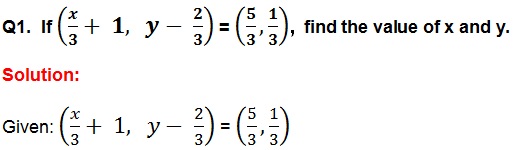
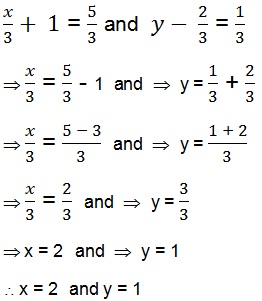
Comparing both side as order pairs are equal, so corresponding elements also will be equal,
Q2. If the set A has 3 elements and the set B = {3, 4, 5}, then find the number of elements in (A×B).
Solution:
Given : n(A) = 3 and set B = {3, 4, 5}
∴ n(B) = 3
Number of elements in (A × B)
= (Number of elements in A) × (Number of elements in B)
= n(A) × n(B)
= 3 × 3
= 9
Q3. If G = {7, 8} and H = {5, 4, 2}, find G × H and H × G.
Solution:
Given: G = {7, 8} and H = {5, 4, 2}
We know that the Cartesian product P × Q of two non-empty sets P and Q is defined as P × Q = {(p, q): p∈ P, q ∈ Q}
∴ G × H = {(7, 5), (7, 4), (7, 2), (8, 5), (8, 4), (8, 2)}
H × G = {(5, 7), (5, 8), (4, 7), (4, 8), (2, 7), (2, 8)}
Q4. State whether each of the following statements are true or false. If the statement is false, rewrite the given statement correctly.
(i) If P = {m, n} and Q = { n, m}, then P × Q = {(m, n),(n, m)}.
(ii) If A and B are non-empty sets, then A × B is a non-empty set of ordered pairs (x, y) such that x ∈ A and y ∈ B.
(iii) If A = {1, 2}, B = {3, 4}, then A × (B ∩ φ) = φ.
Solution:
(i) If P = {m, n} and Q = { n, m}, then P × Q = {(m, n),(n, m)}.
False
If P = {m, n} and Q = {n, m},
P × Q = {(m, m), (m, n), (n, m), (n, n)}
Solution:
(ii) If A and B are non-empty sets, then A × B is a non-empty set of ordered pairs (x, y) such that x ∈ A and y ∈ B.
(ii) True
Solution:
(iii) If A = {1, 2}, B = {3, 4}, then A × (B ∩ φ) = φ.
(iii) True
Q5. If A = {–1, 1}, find A × A × A.
Solution:
It is known that for any non-empty set A, A × A × A is defined as;
A × A × A = {(a, b, c): a, b, c ∈ A}
Given that A = {–1, 1}
∴ A × A × A = {(–1, –1, –1), (–1, –1, 1), (–1, 1, –1), (–1, 1, 1), (1, –1, –1), (1, –1, 1), (1, 1, –1), (1, 1, 1)}
Q6. If A × B = {(a, x),(a , y), (b, x), (b, y)}. Find A and B.
Solution:
The cartesian product of two non-empty sets P and Q is defined as P × Q = {(p, q): p ∈ P, q ∈ Q}
Given that: A × B = {(a, x),(a , y), (b, x), (b, y)}
∴ a, b ∈ A abd x, y ∈ B
So, A = {a, b} and B = {x, y}
Q7. Let A = {1, 2}, B = {1, 2, 3, 4}, C = {5, 6} and D = {5, 6, 7, 8}.
Verify that:
(i) A × (B ∩ C) = (A × B) ∩ (A × C).
(ii) A × C is a subset of B × D.
Solution:
(i) To verify: A × (B ∩ C) = (A × B) ∩ (A × C)
We have B ∩ C = {1, 2, 3, 4} ∩ {5, 6} = Φ
∴ L.H.S. = A × (B ∩ C) = A × Φ = Φ
A × B = {(1, 1), (1, 2), (1, 3), (1, 4), (2, 1), (2, 2), (2, 3), (2, 4)}
A × C = {(1, 5), (1, 6), (2, 5), (2, 6)}
∴ R.H.S. = (A × B) ∩ (A × C) = Φ
∴ L.H.S. = R.H.S
Hence, A × (B ∩ C) = (A × B) ∩ (A × C)
(ii) To verify: A × C is a subset of B × D
Solution:
A × C = {(1, 5), (1, 6), (2, 5), (2, 6)}
A × D = {(1, 5), (1, 6), (1, 7), (1, 8), (2, 5), (2, 6), (2, 7), (2, 8), (3, 5), (3, 6), (3, 7), (3, 8), (4, 5), (4, 6), (4, 7), (4, 8)}
All the elements of set A × C are the elements of set B × D.
Therefore, A × C is a subset of B × D.
Q8. Let A = {1, 2} and B = {3, 4}. Write A × B. How many subsets will A × B have? List them.
Solution:
A = {1, 2} and B = {3, 4}
∴ A × B = {(1, 3), (1, 4), (2, 3), (2, 4)}
⇒ n(A × B) = 4
We know that if C is a set with n(C) = m,
then n[P(C)] = 2m.
Therefore, the set A × B has 24 = 16 subsets.
These are Φ, {(1, 3)}, {(1, 4)}, {(2, 3)}, {(2, 4)}, {(1, 3), (1, 4)}, {(1, 3), (2, 3)}, {(1, 3), (2, 4)}, {(1, 4), (2, 3)}, {(1, 4), (2, 4)}, {(2, 3), (2, 4)}, {(1, 3), (1, 4), (2, 3)}, {(1, 3), (1, 4), (2, 4)}, {(1, 3), (2, 3), (2, 4)}, {(1, 4), (2, 3), (2, 4)}, {(1, 3), (1, 4), (2, 3), (2, 4)}
Q9. Let A and B be two sets such that n(A) = 3 and n(B) = 2. If (x, 1), (y, 2), (z, 1) are in A × B, find A and B, where x, y and z are distinct elements.
Solution:
Given that n(A) =3 and n(B) = 2;
and (x, 1), (y, 2), (z, 1) are in A × B.
We know that A = Set of first elements of the ordered pair elements of A × B
B = Set of second elements of the ordered pair elements of A × B.
∴ x, y, and z are the elements of A; and 1 and 2 are the elements of B.
Since n(A) = 3 and n(B) = 2,
∴ A = {x, y, z} and B = {1, 2}.
Q10. The Cartesian product A × A has 9 elements among which are found (–1, 0) and (0,1). Find the set A and the remaining elements of A × A.
Solution:
We know that if n(A) = p and n(B) = q,
then n(A × B) = pq.
∴ n(A × A) = n(A) × n(A)
It is given that n(A × A) = 9
∴ n(A) × n(A) = 9 ⇒ n(A) = 3
The ordered pairs (–1, 0) and (0, 1) are two of the nine elements of A×A.
We know that A × A = {(a, a): a ∈ A}.
Therefore, –1, 0, and 1 are elements of A.
Since n(A) = 3,
it is clear that A = {–1, 0, 1}.
The remaining elements of set A × A are (–1, –1), (–1, 1), (0, –1), (0, 0), (1, –1), (1, 0), and (1, 1).
Exercise 2.1 are created by experts to give step-by-step explanations. Around 60–70% of exam questions are based on NCERT concepts. Our 11 Mathematics Chapter 2. Relations and Functions solutions help you understand the core concepts and practice effectively.
Revision is the key to exam success. Our notes for 11 Mathematics highlight important formulas, key definitions, and exam-ready points from Chapter 2. Relations and Functions. These quick revision notes make last-minute preparation easy.
Every NCERT chapter ends with exercises, and solving them is crucial. Our Exercise 2.1 include complete solutions for 11 Mathematics Chapter 2. Relations and Functions exercises. With step-by-step answers, you gain clarity and confidence to attempt similar exam questions.
To boost your preparation, we also provide additional important questions with answers. These are prepared from previous year board papers, sample papers, and important concepts of Chapter 2. Relations and Functions. Practicing these ensures you are well-prepared for both board and mid-term exams.
Our Exercise 2.1 are useful for both board exams and mid-term exams. For 11 Mathematics, we provide notes, exercises, and important Q&A so that you can revise smartly and write perfect answers in exams.
In short, Exercise 2.1 for 11 Mathematics Chapter 2. Relations and Functions are a complete study package. With quick revising points, NCERT exercises, and additional important questions, you can prepare effectively for exams. Make these solutions your study companion and excel in your academic journey.
Go to other Class
Download worksheets and assignments for better practice and revision.