 Toppers Study Toppers Study Toppers Study
Detailed NCERT Solutions for 11 Mathematics 4. Principle Of Mathematical Induction to simplify learning. Understand chapters clearly and practice with free solutions for better results.

Detailed NCERT Solutions for 11 Mathematics 4. Principle Of Mathematical Induction to simplify learning. Understand chapters clearly and practice with free solutions for better results.
Preparing for exams becomes easier with Exercise 4.1. Whether you are studying for board exams or mid-term exams, 11 Mathematics Chapter 4. Principle Of Mathematical Induction solutions provide quick revising points, well-structured answers, and additional practice material to help you score better.
ncert_solutionsChapter 4. Principle of Mathematical induction
Exercise 4.1
Prove the following by using the principle of mathematical induction for all n ∈ N:

Solution:
Let the given statement be P(n), i.e.,
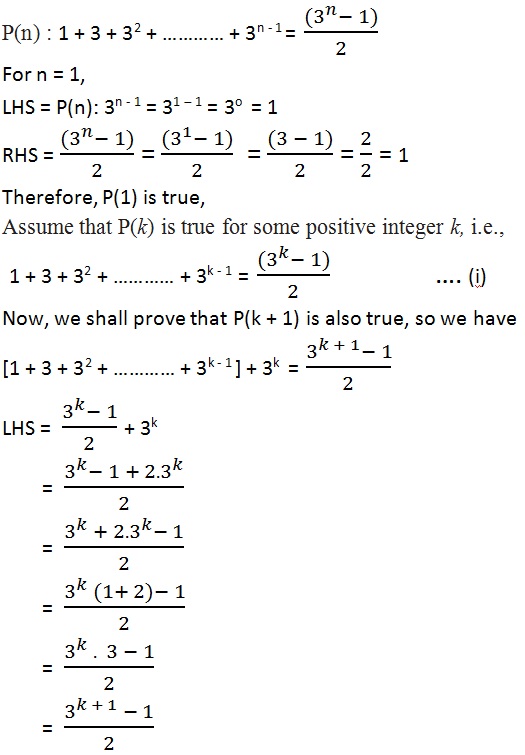
LHS = RHS
Thus P(k + 1) is true, whenever P (k) is true.
Hence, from the principle of mathematical induction, the statement P(n) is true for all natural numbers n.

Solution:
Let the given statement be P(n), i.e.,
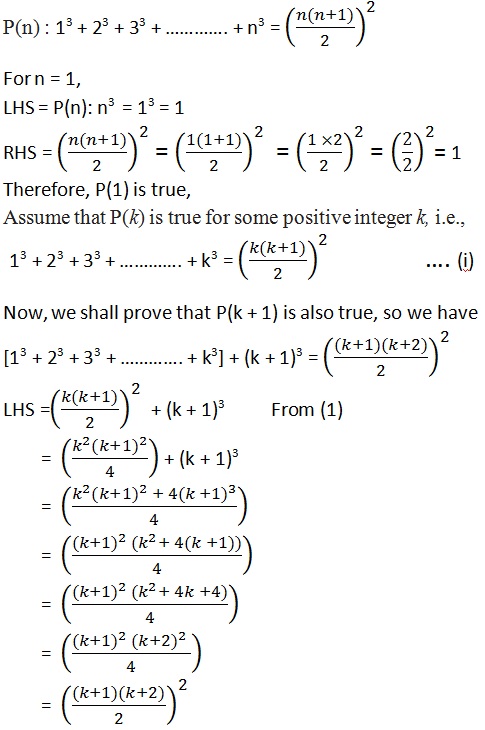
LHS = RHS
Thus P(k + 1) is true, whenever P (k) is true.
Hence, from the principle of mathematical induction, the statement P(n) is true for all natural numbers n.

Solution: Let the given statement be P(n), so
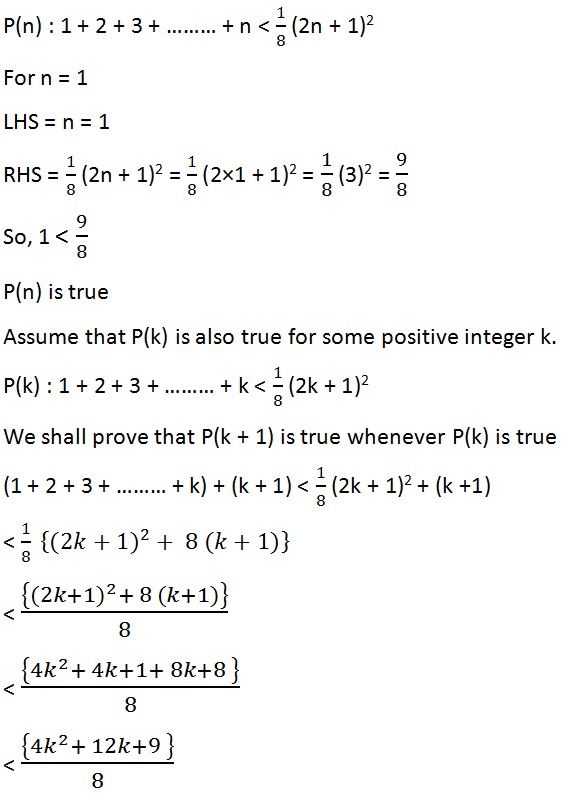
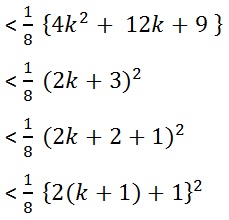
Thus P(k + 1) is true, whenever P (k) is true.
Hence, from the principle of mathematical induction, the statement P(n) is true for all natural numbers n.
Q19. n (n + 1) (n + 5) is a multiple of 3.
Solution:
Let the given statement be P(n), so
P(n) : n (n + 1) (n + 5) is a multiple of 3.
For n = 1, so we have;
n (n + 1) (n + 5) = 1 × 2 × 6 = 12 = 3 × 4
P(n) is true for n = 1
Assume that P(k) is also true for some positive integer k.
k(k + 1) (k + 5)
= k3 + 6k2 + 5 k = 3m (say) ……………….. (1)
Now, we shall prove that P(k + 1) is true whenever P(k) is true
Replacing k by k + 1
k + 1 (k + 2) (k + 6)
= (k + 1) (k2 + 8k + 12)
= k (k2 + 8k + 12) + 1(k2 + 8k + 12)
= k3 + 8k2 + 12k + k2 + 8k + 12
= k3 + 9k2 + 20k + 12
=( k3 + 6k2 + 5 k) + 3k2 + 15k + 12
= 3m + 3k2 + 15k + 12 from (1)
= 3(m + k2 + 5k + 4)
∴ k + 1 (k + 2) (k + 6) is multiple of 3
Thus P(k + 1) is true, whenever P (k) is true.
Hence, from the principle of mathematical induction, the statement P(n) is true for all natural numbers n ∈ N.
Q20. 102n - 1 + 1 is divisible by 11.
Solution:
Let the given statement be P(n), so
P(n) : 102n - 1 + 1 is divisible by 11.
For n = 1, so we have;
102n - 1 + 1 = 102×1 - 1 + 1 = 10 + 1 = 11
P(n) is true for n = 1
Assume that P(k) is also true for some positive integer k.
102k- 1 + 1 = 11m say
102k- 1 = 11m - 1 ……………… (1)
We shall prove that P(k + 1) is true whenever P(k) is true
∴ replacing k by k + 1 we have
102k - 1 + 1
= 102k + 1 + 1
= 102k × 101 + 1
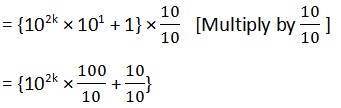
= {102k - 1 × 100 + 1}
= {(11m - 1)× 100 + 1} from equation (1)
= 1100m - 100+ 1
= 1100m - 99
= 11(100m - 9)
∴ 102n - 1 + 1 is divisible by 11
Thus P(k + 1) is true, whenever P(k) is true.
Hence, from the principle of mathematical induction, the statement P(n) is true for all natural numbers n ∈ N.
Q21. x2n – y2n is divisible by x + y
Solution: Let the given statement be P(n), so
P(n) : x2n – y2n is divisible by x + y
Putting n = 1 we have,
x2n – y2n = x2 - y2 = (x + y) (x - y)
P(n) is true for n = 1
Assume that P(k) is also true for some positive integer k or
x2k – y2k is divisible by (x + y)
So, x2k – y2k = m( x + y)
Or x2k = m( x + y) + y2k …………. (1)
We shall prove that P(k + 1) is true whenever P(k) is true
∴ replacing k by k + 1 we have
x2k + 2 – y2k + 2
= x2k . x2 – y2k .y2
Putting the value of x2k from (1)
= {m( x + y) + y2k} x2 – y2k .y2
= m( x + y) x2 + y2k. x2 – y2k .y2
= m( x + y) x2 + y2k (x2 – y2)
= m( x + y) x2 + y2k (x + y) ( x - y)
= ( x + y) [mx2 + y2k ( x - y)]
∴ x2n – y2n is divisible by x + y
Thus P(k + 1) is true, whenever P(k) is true.
Hence, from the principle of mathematical induction, the statement P(n) is true for all natural numbers n ∈ N.
Q22. 32n+2 – 8n – 9 is divisible by 8
Solution: Let the given statement be P(n), so
P(n) : 32n+2 – 8n – 9 is divisible by 8
Putting n =1
P(1) : 32×1+2 – 8 × 1 – 9 = 81 - 17 = 64 = 8 × 8
Which is divisible by 8
∴ P(1) is true
Assume that P(k) is also true for some positive integer k
32k + 2 – 8k – 9
32k + 2 – 8k – 9 is divisible by 8
32k + 2 – 8k – 9 = 8m
Or 32k + 2 = 8m + 8k + 9 ……………. (1)
We shall prove that P(k + 1) is true whenever P(k) is true
∴ replacing k by k + 1 we have
32k + 4 – 8k – 8 – 9
= 32k + 4 – 8k – 17
= 32k + 2 × 32 – 8k – 17
= (8m + 8k + 9)× 9 – 8k – 17
= 72m + 72k + 81 – 8k – 17
= 72m + 64k + 64
= 8(9m + 8k + 8)
∴ 32n+2 – 8n – 9 is divisible by 8
Thus P(k + 1) is true, whenever P(k) is true.
Hence, from the principle of mathematical induction, the statement P(n) is true for all natural numbers n ∈ N.
Q23. 41n – 14n is a multiple of 27.
Solution: Let the given statement be P(n), so
P(n) : 41n – 14n is a multiple of 27
Putting n = 1
P(1): 41n – 14n = 41 – 14 = 27
∴ P(1) is true
Assume that P(k) is also true for some positive integer k
41k – 14k = 27
41k = 27 + 14k ………… (1)
We shall prove that P(k + 1) is true whenever P(k) is true
∴ replacing k by k + 1 we have
41k + 1 – 14k + 1
= 41k . 41 – 14k . 14
= (27 + 14k) 41 – 14k . 14
= 27 . 41 + 14k .41 – 14k . 14
= 27 . 41 + 14k (41 – 14 )
= 27 . 41 + 14k . 27
= 27 ( 41 + 14k )
∴ 41n – 14n is a multiple of 27
Thus P(k + 1) is true, whenever P(k) is true.
Hence, from the principle of mathematical induction, the statement P(n) is true for all natural numbers n ∈ N.
Q24. (2n + 7) < (n + 3)2
Solution: Let the statement be p(n) so,
p(n) : (2n + 7) < (n + 3)2
=> p(1) : (2 × 1 + 7) < (1 + 3)2
=> 9 < 42
=> 9 < 16
Therefore, p(1) is true so Assume that p(k) is also true for some integer k.
(2k + 7) < (k + 3)2 ......... (i)
Now we shall prove for p(k + 1)
2(k +1) + 7 < (k + 1 + 3)2
2k + 2 + 7 < (k + 4)2 ........ (ii)
We have from (i)
(2k + 7) < (k + 3)2
Adding 2 both sides
=> 2k + 7 + 2 < (k + 3)2 + 2
=> 2k + 7 + 2 < k2 + 6k + 9 + 2
=> 2k + 7 + 2 < k2 + 6k + 9 + 2
=> 2k + 7 + 2 < k2 + 6k + 11
Now, k2 + 6k + 11 < (k + 4)2 from (ii)
=> 2k + 7 + 2 < k2 + 6k + 11 < k2 + 8k + 16
=> 2k + 2 + 7 < k2 + 8k + 16
=> 2(k + 1) + 7 < (k + 4)2
=> 2(k + 1) + 7 < (k + 1 + 3)2
Thus P(k + 1) is true, whenever P(k) is true.
Hence, from the principle of mathematical induction, the statement P(n) is true for all natural numbers n ∈ N.
Exercise 4.1 are created by experts to give step-by-step explanations. Around 60–70% of exam questions are based on NCERT concepts. Our 11 Mathematics Chapter 4. Principle Of Mathematical Induction solutions help you understand the core concepts and practice effectively.
Revision is the key to exam success. Our notes for 11 Mathematics highlight important formulas, key definitions, and exam-ready points from Chapter 4. Principle Of Mathematical Induction. These quick revision notes make last-minute preparation easy.
Every NCERT chapter ends with exercises, and solving them is crucial. Our Exercise 4.1 include complete solutions for 11 Mathematics Chapter 4. Principle Of Mathematical Induction exercises. With step-by-step answers, you gain clarity and confidence to attempt similar exam questions.
To boost your preparation, we also provide additional important questions with answers. These are prepared from previous year board papers, sample papers, and important concepts of Chapter 4. Principle Of Mathematical Induction. Practicing these ensures you are well-prepared for both board and mid-term exams.
Our Exercise 4.1 are useful for both board exams and mid-term exams. For 11 Mathematics, we provide notes, exercises, and important Q&A so that you can revise smartly and write perfect answers in exams.
In short, Exercise 4.1 for 11 Mathematics Chapter 4. Principle Of Mathematical Induction are a complete study package. With quick revising points, NCERT exercises, and additional important questions, you can prepare effectively for exams. Make these solutions your study companion and excel in your academic journey.
Go to other Class
Download worksheets and assignments for better practice and revision.