 Toppers Study Toppers Study Toppers Study
Get complete NCERT Solutions for 10 Science 8. How do Organisms Reproduce with detailed explanations. Easy-to-understand answers to help students study effectively and score better.
Get complete NCERT Solutions for 10 Science 8. How do Organisms Reproduce with detailed explanations. Easy-to-understand answers to help students study effectively and score better.
Preparing for exams becomes easier with Exercise. Whether you are studying for board exams or mid-term exams, 10 Science Chapter 8. How do Organisms Reproduce solutions provide quick revising points, well-structured answers, and additional practice material to help you score better.
ncert_solutionsExercises:
Q1. Asexual reproduction takes place through budding in
(a) amoeba.
(b) yeast.
(c) plasmodium.
(d) leishmania.
Answer: (b) yeast
Q2. Which of the following is not a part of the female reproductive system in human beings?
(a) Ovary
(b) Uterus
(c) Vas deferens
(d) Fallopian tube
Answer: (c) Vas deferens
Q3. The anther contains
(a) sepals.
(b) ovules.
(c) carpel.
(d) pollen grains.
Answer: (d) pollen grains.
Q4. What are the advantages of sexual reproduction over asexual reproduction?
Answer: The advantages of sexual reproduction over asexual reproduction are as follows:
(i) There are much variations in the organisms reproduced by sexual reproduction than of the asexual reproduction.
(ii) It plays an important role in speciation.
(iii) There are much options to combine of new variations of DNA.
(iv) The new indivisual is differ to parent in physically but similar at DNA level.
(v) The sexual reproduction encourrages much new features in offspring as it occurs by fission of two difference gamates while there is no so happens in asexual reproduction.
Q5. What are the functions performed by the testis in human beings?
Answer: Function of testis in human beings:
(i) It produces male gamate sperms.
(ii) It releases male sex hormone testosterone.
Q6. Why does menstruation occur?
Answer: A girl with puberty performs menstruation when an egg does not fertilise. After releasing ovum(egg) comes in fallopian tube and if here it comes in the contact of male gamate sperm the fertilisation takes place but if fertilisation does not take place it comes down in the uterus and after 3 to 4 days it gets degenerated and mixed with blood and mucus comes out of uterus. This is called menstruation and it occurs after every 28 days.
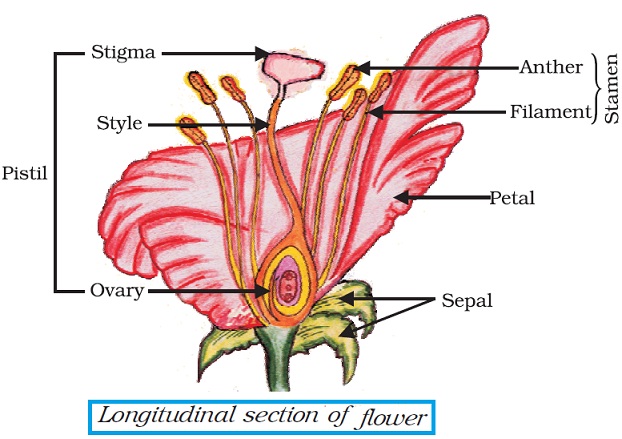
Q7. Draw a labelled diagram of the longitudinal section of a flower.
Answer:
Q8. What are the different methods of contraception?
Answer: There are following contraception methods:
(i)
Q9. How are the modes for reproduction different in unicellular and
multicellular organisms?
Q10. How does reproduction help in providing stability to populations of species?
Q11. What could be the reasons for adopting contraceptive methods?
Exercise are created by experts to give step-by-step explanations. Around 60–70% of exam questions are based on NCERT concepts. Our 10 Science Chapter 8. How do Organisms Reproduce solutions help you understand the core concepts and practice effectively.
Revision is the key to exam success. Our notes for 10 Science highlight important formulas, key definitions, and exam-ready points from Chapter 8. How do Organisms Reproduce. These quick revision notes make last-minute preparation easy.
Every NCERT chapter ends with exercises, and solving them is crucial. Our Exercise include complete solutions for 10 Science Chapter 8. How do Organisms Reproduce exercises. With step-by-step answers, you gain clarity and confidence to attempt similar exam questions.
To boost your preparation, we also provide additional important questions with answers. These are prepared from previous year board papers, sample papers, and important concepts of Chapter 8. How do Organisms Reproduce. Practicing these ensures you are well-prepared for both board and mid-term exams.
Our Exercise are useful for both board exams and mid-term exams. For 10 Science, we provide notes, exercises, and important Q&A so that you can revise smartly and write perfect answers in exams.
In short, Exercise for 10 Science Chapter 8. How do Organisms Reproduce are a complete study package. With quick revising points, NCERT exercises, and additional important questions, you can prepare effectively for exams. Make these solutions your study companion and excel in your academic journey.
Go to other Class
Download worksheets and assignments for better practice and revision.