 Toppers Study Toppers Study Toppers Study
Get complete NCERT Solutions for 10 Science 4. Carbon and its Compounds with detailed explanations. Easy-to-understand answers to help students study effectively and score better.
Get complete NCERT Solutions for 10 Science 4. Carbon and its Compounds with detailed explanations. Easy-to-understand answers to help students study effectively and score better.
Preparing for exams becomes easier with Additional Questions With Solutions. Whether you are studying for board exams or mid-term exams, 10 Science Chapter 4. Carbon and its Compounds solutions provide quick revising points, well-structured answers, and additional practice material to help you score better.
ncert_solutionsChapter-4, Carbon
Long-Type Questions and Answers:
Q1: Distinguish between saturated and unsaturated compound . which of them is more reactive.
Ans:
|
Saturated compound |
unsaturated compound |
|
|
Unsaturated compound is more reactive than saturated compound.
Q2: What do you understand by functional group?
Ans: Functional group is a group of an atom or atoms in any carbonic compound which are bonded each other in special manner. That is generally region of chemical reactivity in carbonic atoms. Oxygen, chlorine, sulpher, nitrogen and other elements can be presence as a part of a functional group in carbonic compounds.
Ex. - -CHO, >C=O, -OH, -COOH etc.
Q3: An organic Compound A is widely used as a preservative in pickles and has a molecular formula C2 H2 O2. This compound reacts with ethanol to form a sweet smelling Compound B.
(a) Identify the Compound A and B.
(b) Write the chemical equation with ethanol to from compound B.
(c) How can we get compound A back from B.
(d) Name the process and write equations?.
(e) Which gas is produced when compound A reacts with washing Soda? Write the chemical equations?
Ans:
(a) A is Ethanoic acid or acetic acid and B is ester.
(b) The chemical equation with ethanol to form compound B is

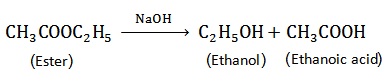
(c) Esters reat in the presence of an acid or base to give back the alcohol and Ethanoic acid (carboxylic acid).
(d) This reaction (process) is called soapnification. The reaction equation is as
(e) CO2 gas is produced, when the compound A (Ethanoic acid) reacts with washing soda (NaHCO3). This reaction is as;
CH3COOH + NaHCO3 → CH3COONa + H2O + CO2
Q4: How would you distinguish experimentally between alcohol and ethanoic acid.
Ans:
| Ethanole | Ethanoic Acid |
|
1. Ethanol is an alcohol with sweet smell. 2. It does not react with NaOH. 3. It reacts with alkaline KMnO4 to give ethanoic acid. 4. It does not effect on litmus paper. |
1. Ethenoic acid is a acid with odorless heighly smelling. 2. It reacts with NaOH to give salt and water. 3. It does not react with alkaline KMnO4. 4. It turns blue litmus paper into red. |
Q5: What happens when ethanol reacts with sodium. Write a chemical reaction.
Ans: When ethanol reacts with sodium produces sodium ethoxide and evolves hydrogen gas.
Equation of this reaction is as follows:
2Na + 2CH3CH2OH → 2CH3CH2O–Na+ + H2
Q6: What happens when ethanol is heated with.
(i) Alkaline KMnO4
(ii) H2SO4 at 443 K
Write their equations.
Ans:
(i) When ethanol is heated with alkaline KMnO4 it gives carboxylic acids and water. Alkaline potassium permanganate or acidified potassium dichromate are oxidising alcohols to acids, that is, adding oxygen to the starting material. Hence they are known as oxidising agents.
Equation for this reaction:

(ii) Heating ethanol at 443 K with excess concentrated sulphuric acid results in the dehydration of ethanol to give ethene-

Q7: Give one example of addition reaction.
Ans:

Q8: Give one example of substitution reaction.
Ans: CH4 + Cl2 → CH3Cl + HCl (in the presence of sunlight)
Q9: What are saturated and unsaturated carbon compounds ? Give one example each.
Ans:
Saturated carbon compounds: The carbon compounds which forms single bond is called saturated hydro carbon. Example - Alkanes.
Unsaturated carbon compounds: The carbon compounds which forms double and triple bond is called saturated hydro carbon. Example - Alkanes.
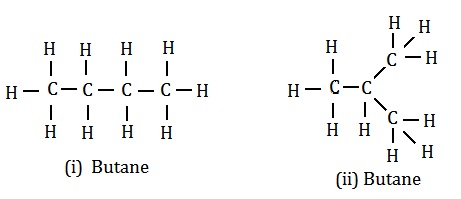
Q10: Draw structural isomers of C4H10.
Ans: structural isomers of C4H10
Q11: Name the following compounds
(i) CH3 - CH2 - Br
(ii) CH3 - CH2 - CHO
Ans:
(i) Bromo-Ethane,
(ii) Propanal,
Q12: What is the region that saturated hydrocarbons give even sooty flame in incomplete combustion?
Ans: Saturated hydrocarbons will generally give a clean flame, but when a sooty deposit on the metal plate causes limiting supply of air results in incomplete combustion of even saturated hydrocarbons gives a sooty flame.
Que – What is oxidation?
Ans – The reaction in which compounds like carbon can be easily oxidised on the combustion, this process is known as oxidation.
Que – Define Addition reaction?
Ans – The reaction in which adds the substances is known as Addition reaction. This reaction is commonly used in the hydrogenation of vegetable oils using a nickel catalyst.
Que – What are catalysts? Give its two examples.
Ans – Catalysts are substances that cause a reaction to occur or proceed at a different rate without the reaction itself being affected. Palladium or Nickel is catalysts.
Que - What is hydrogenation? What is its industrial application?
Ans - Unsaturated hydrocarbons add hydrogen in the presence of catalysts such as palladium or nickel to give saturated hydrocarbons is called hydrogenation. This reaction is commonly used in the hydrogenation of vegetable oils using a nickel catalyst in industry.
Que - What is a homologous series? Explain with an example.
Ans - a series of compounds in which the same functional group substitutes for hydrogen in a carbon chain is called a homologous series.
For example, the chemical properties of CH3OH, C2H5OH, C3H7OH and C4H9OH are all very similar as these are from alcohol functional group. Thus, CH3 – Cl, C2H5 – Cl, C3H7 – Cl, C4 H9 – Cl, and C5 H11 – Cl etc. are related to halogen functional group.
Que - Why are carbon and its compounds used as fuels for most applications?
Ans – Because most carbon compounds release a large amount of heat and light on burning.
Additional Questions With Solutions are created by experts to give step-by-step explanations. Around 60–70% of exam questions are based on NCERT concepts. Our 10 Science Chapter 4. Carbon and its Compounds solutions help you understand the core concepts and practice effectively.
Revision is the key to exam success. Our notes for 10 Science highlight important formulas, key definitions, and exam-ready points from Chapter 4. Carbon and its Compounds. These quick revision notes make last-minute preparation easy.
Every NCERT chapter ends with exercises, and solving them is crucial. Our Additional Questions With Solutions include complete solutions for 10 Science Chapter 4. Carbon and its Compounds exercises. With step-by-step answers, you gain clarity and confidence to attempt similar exam questions.
To boost your preparation, we also provide additional important questions with answers. These are prepared from previous year board papers, sample papers, and important concepts of Chapter 4. Carbon and its Compounds. Practicing these ensures you are well-prepared for both board and mid-term exams.
Our Additional Questions With Solutions are useful for both board exams and mid-term exams. For 10 Science, we provide notes, exercises, and important Q&A so that you can revise smartly and write perfect answers in exams.
In short, Additional Questions With Solutions for 10 Science Chapter 4. Carbon and its Compounds are a complete study package. With quick revising points, NCERT exercises, and additional important questions, you can prepare effectively for exams. Make these solutions your study companion and excel in your academic journey.
Go to other Class
Download worksheets and assignments for better practice and revision.