 Toppers Study Toppers Study Toppers Study
Get CBSE Notes for Class 10 Science – 10. Light-Reflection and Refraction: Introduction. Clear, exam-focused notes with key concepts, formulas & solved examples.
CBSE Notes for Class 10 Science chapter 10. Light-Reflection and Refraction: Introduction, quick revision notes for Class 10 Science chapter 10. Light-Reflection and Refraction Introduction, Chapter-wise CBSE Revision Notes, CBSE Notes PDF Free Download, CBSE One Liner Notes Class 10, Half Yearly Revision Notes, CBSE Revision Notes Class 10 Science
Get CBSE Notes for Class 10 Science Chapter 10. Light-Reflection and Refraction: Introduction prepared by experts as per the latest NCERT syllabus and CBSE exam pattern. These concise and easy-to-understand notes cover important definitions, formulas, diagrams, and key concepts from the chapter to help students in quick revision and effective exam preparation. Whether you are studying for school tests, board exams, or competitive exams, these notes provide a reliable study resource. Designed in simple language with point-wise explanations, they save time and enhance learning efficiency. Download free PDF notes, explore solved examples, and strengthen your understanding of [Topic Name] for scoring high marks. Perfect for Class 10 students who want clear, structured, and exam-oriented notes for CBSE Science.
10. Light-Reflection and Refraction
Light makes things visible. The sun light helps us to see the objects during light.
How we able to see any object?
An object reflects light that falls on it. This reflected light, when received by our eyes, enables us to see things.
A ray of light: When light travels from its source of light, it looks like straight line, this line is called a ray of light.
Shadow: When a beam of light pass through an opaque object and get reflected and it form a shadow of that opaque object.
Diffraction of light : If an opaque object on the path of light becomes very small, light has a tendency to bend around it and not walk in a straight line – an effect known as the diffraction of light.
When a ray of light falls on polished surface, it turns or reflects most of the light in the same medium from which it comes. This phenomenom is known as reflection of light.
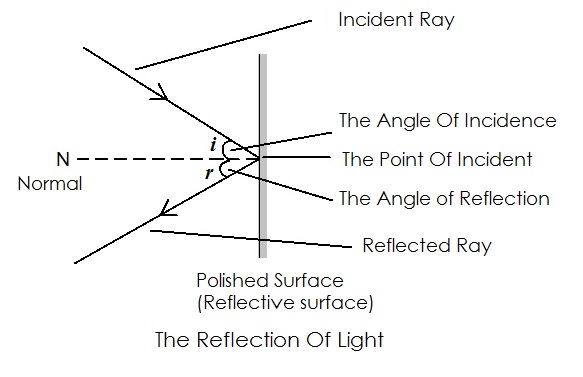
The laws of reflection of light:
(i) The angle of incidence is equal to the angle of reflection, and
(ii) The incident ray, the normal to the mirror at the point of incidence and the reflected ray, all lie in the same plane.
These laws of reflection are applicable to all types of reflecting surfaces
including spherical surfaces.
Some common wonderful phenomena
There occur some common wonderful phenomena due to reflection of light. These are followings;
Image formation by mirrors, the twinkling of stars, the beautiful colours of a rainbow, bending of light by a medium.
Type of Reflection:
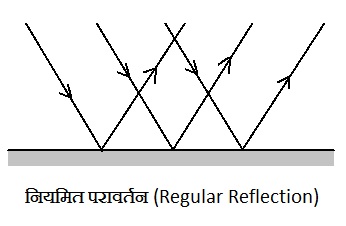
1. Specular or regular reflection: Such type of reflection takes place from shiny or polished surface and incident rays remain parallel to each other after reflection.
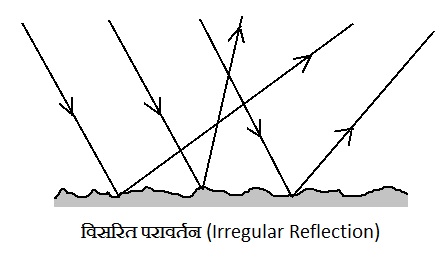
2. Diffused or irregular reflection: Such type of reflection takes place from
rough surface and incident rays do not remain parallel to each other after
reflection.
Mirror : This is a shiny and more polished reflecting surface, which make the image of an object kept front of it.
Types of Mirror:
There are two types of mirror.
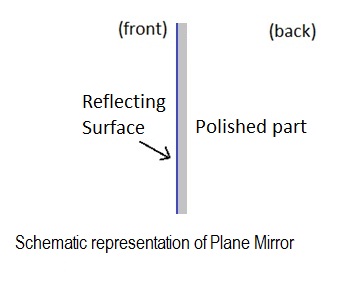
(A) Plane Mirror : Its reflecting surface is straight and flat.
(B) Spherical Mirror : It has curved reflecting surface. This curved reflecting surface can be curved inward or out outwart.
On the basis of this curvature, spherical mirror are two types.
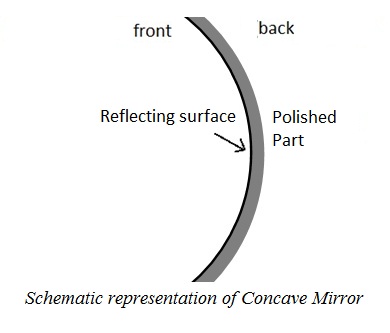
(i) Concave Mirror : Its reflecting surface is inward.
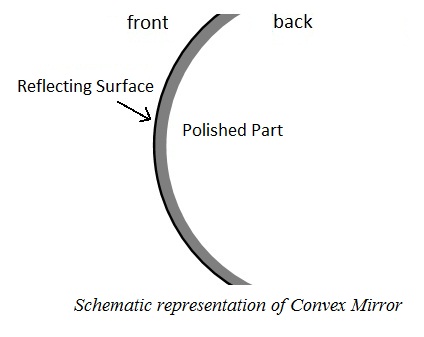
(ii) Convex Mirror : Its reflecting surface is outward.
The Parts Of Spherical Mirror :
(i) Pole : The centre of reflecting surface of spherical mirror is called its pole. It is denoted by English letter P.
(ii) The Centre of Curvature : The reflecting surface of a spherical mirror forms a part of a sphere. This sphere has a centre. This point is called the centre of curvature of the spherical mirror.
(iii) The Radius of Curvature : The distance between Pole of the spherical mirror and the center of curvature is known as the radius of curvature.
(iv) Principal Axis : The straight line passing through the pole and the centre of curvature of spherical mirror is known as principal axis.
(v) Principal Focus : There is an another point F on principal axis lie between half of the pole and the center of curvature which is called the principal focus. Incident rays parallel to the principal axis intersect at principal focus after reflection in concave mirror and it seems to intersect in convex mirror.
(vi) Focal Length : Distance between the pole and the principal focus of the mirror is called Focal Length. It is denoted by small 'f' of English alphabets. This distance is half of the radius of the curvature.
(vii) Aperture : The reflecting surface of a spherical mirror is by and large spherical. The surface, then, has a circular outline. The diameter of the reflecting surface of spherical mirror is called its aperture.
The Position, Nature and Size of Image:
The position of object: The place where an object is placed.
The position of Image : The place where mirror forms the image of an
object.
The Size of Image : This is the size of image which tells that the image of object is formed either smaller or larger than the object.
The nature of image : It is known by the nature of image that what type of image is formed by mirror like virtual and errect or real and inverted.
There are two types of nature of images.
(i) Real and inverted : This types of images always form infront of mirror.
(ii) Virtual and errect : This types of images always form behind the mirror.
Image Formation by Spherical Mirrors:
The formation of image in concave mirror is depended on the position of an object. An object placed between the pole (P) and principal focus (F) form only virtual and errect image otherwise all others images are real and inverted that kept any other places before the concave mirror.
Some positions, natures and sizes of images formed by concave mirror.
Use Of Concave Mirror:
(i) Concave mirrors are commonly used in torches, search-lights and vehicles headlights to get powerful parallel beams of light.
(ii) They are often used as shaving mirrors to see a larger image of the face.
(iii) Concave mirrors are used to see large images of the teeth of patients by the dentists.
(iv) Large concave mirrors are used to concentrate sunlight to produce heat in solar furnaces.
Image Formation By Convex mirror:
The image formed by convex mirror is always virtual and errect and smaller than the object.
Use Of Convex Mirror:
(i) Convex mirrors are commonly used as rear-view (wing) mirrors in vehicles.
(ii) It is used as reflector for street lighting purposes.
(iii) Convex mirrors are useful for inspecting places difficult to get to.
(iv) convex mirrors are also used for security situations.
Sign Convention for Reflection by Spherical Mirrors:
Reflection of light by spherical mirrors form a cartesian plane which is a
set of sign conventions called the New Cartesian sign Convention.
These are as follows -
Mirror Formula:
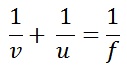
Uses of Mirror formula:
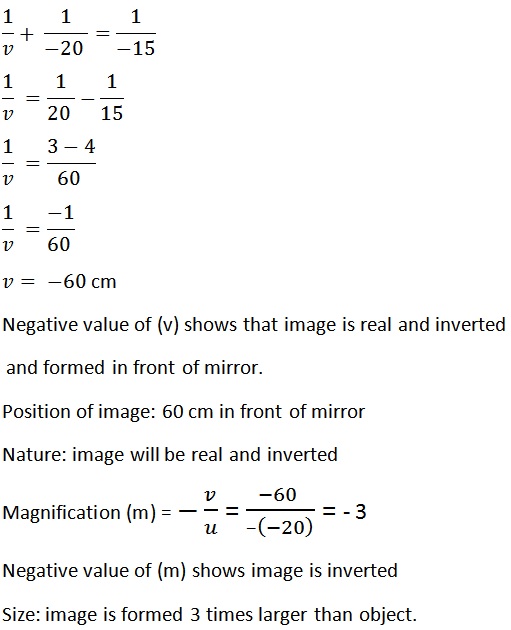
Example 1: An object is placed 20 cm in front of a concave mirror of focal length 15 cm. Find the position of object, nature and size of image.
Solution:
Object-distance (u) = - 20 cm [ Distance of object is always negative (-) ]
focal length (f) = - 15 cm [Focal length in concave mirror is negative (-) ]
Image-Distance (v) = ?
Using mirror formula;
Example 2. An object of height 5 cm is placed 15 cm away from a convex mirror of focal length 15 cm. Find the position, nature and size of image formed.
Solution:
Object-distance (u) = -15 cm
Focal length (f) = 15 cm [ Focal length in convex mirror is positive (+) ]
Image-distance (v) = ?
Using mirror formula:
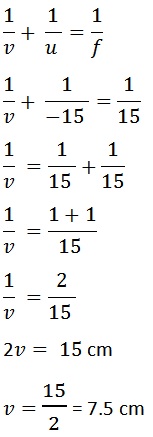
Position of image: 7.5 cm back of mirror
Nature of image: Vertual and irect

Size: Half of the object (smaller).
For students preparing for board exams or competitive assessments, CBSE notes have become an indispensable tool. These notes summarize the NCERT textbooks, highlighting key concepts, formulas, definitions, and diagrams in a concise and easy-to-understand format. Unlike lengthy textbooks, CBSE notes allow students to focus on the most important points, saving valuable time during revision.
In conclusion, CBSE notes are not just a revision tool—they are a strategy. When used correctly, they help students cover the syllabus efficiently, improve retention, and approach exams with confidence. For exam-going students, the combination of structured notes, practice, and consistent revision is the key to achieving top results.
Ace your exams with CBSE Notes for Class 10 Science chapter 10. Light-Reflection and Refraction: Introduction. These notes provide a clear explanation of important concepts, formulas, diagrams, and solved examples from the NCERT syllabus. Specially designed for Class 10 students, the notes are structured in a simple, point-wise manner to make revision quick and effective. Whether you are preparing for school tests, board exams, or competitive exams, these Science notes will boost your confidence and save valuable study time. You can also download Science class 10 chapter 10. Light-Reflection and Refraction free PDF notes for offline learning. With easy-to-grasp language, exam tips, and well-organized content, these CBSE Science notes on chapter 10. Light-Reflection and Refraction – Introduction are the perfect study companion for scoring high marks and mastering the subject.
CBSE class 10 Science notes are available completely free in PDF, and these all notes are quick revising materials that help you prepare for your upcoming board exams. Students can easily access CBSE notes pdf free download class 10 Science and get free CBSE notes class 10 Science notes designed strictly as per the latest NCERT syllabus. These Class 10 CBSE notes and Class 10 Science notes are short, simple, and to the point, making them perfect for last-minute revisions. You can also refer to NCERT book notes for class 10 that cover every chapter in an easy-to-understand manner. With these Quick revision notes Science class 10, you save time while covering all important formulas, definitions, and concepts.
Download worksheets and assignments for better practice and revision.