 Toppers Study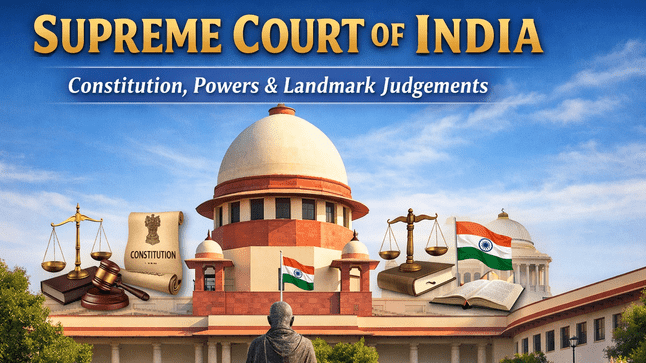
Supreme Court of India – Complete Guide for UPSC (Structure, Powers, Jurisdiction, Landmark Judgements, Basic Structure Doctrine)
The Supreme Court of India is the highest judicial authority in the country and the guardian of the Constitution. It acts as the final interpreter of the Constitution and protects the fundamental rights of citizens.
The Supreme Court was established on 26 January 1950 after the Constitution of India came into force. It replaced the Federal Court of India and the Judicial Committee of the Privy Council which earlier served as the highest courts of appeal.
The provisions relating to the Supreme Court are mentioned in Part V of the Constitution (Articles 124 to 147).
Importance of the Supreme Court in Indian Democracy
The Supreme Court plays a crucial role in maintaining the democratic structure of India. It ensures that the Constitution remains supreme and that the government functions within constitutional limits.
- Guardian of the Constitution
- Protector of Fundamental Rights
- Final court of appeal
- Interpreter of the Constitution
- Ensures rule of law
Historical Background of the Supreme Court
Before independence, India had the Federal Court established in 1937. Appeals from the Federal Court were sent to the Privy Council in London.
After independence, the Constitution of India created a unified judicial system with the Supreme Court at the top.
On 26 January 1950, the Supreme Court began functioning as the highest court of the land.
Composition of the Supreme Court
According to Article 124, the Supreme Court consists of:
- Chief Justice of India (CJI)
- Other Judges appointed by the President
Originally the court had 8 judges. Today the sanctioned strength is:
1 Chief Justice + 33 Judges
Appointment of Judges
The judges of the Supreme Court are appointed by the President of India.
Currently the appointment follows the Collegium System.
Collegium System
The collegium consists of:
- Chief Justice of India
- Four senior-most judges of the Supreme Court
The collegium recommends names for judicial appointments to the President.
Qualifications of Judges
A person must fulfill the following qualifications:
- Must be a citizen of India
- Must have served as High Court judge for at least 5 years
- Must have been an advocate in High Court for at least 10 years
- Or must be a distinguished jurist
Tenure of Judges
Supreme Court judges serve until the age of 65 years.
They may resign or be removed through impeachment by Parliament.
Removal of Judges
A Supreme Court judge can be removed only through impeachment.
Grounds for removal:
- Proved misbehavior
- Incapacity
Both Houses of Parliament must pass the motion with a special majority.
Jurisdiction of the Supreme Court
The Supreme Court exercises multiple jurisdictions.
- Original Jurisdiction
- Appellate Jurisdiction
- Advisory Jurisdiction
- Writ Jurisdiction
Original Jurisdiction (Article 131)
The Supreme Court has exclusive jurisdiction in disputes between:
- Centre and States
- Two or more States
Appellate Jurisdiction
The Supreme Court hears appeals from High Courts in:
- Civil cases
- Criminal cases
- Constitutional matters
Advisory Jurisdiction (Article 143)
The President can seek the opinion of the Supreme Court on important constitutional questions.
Writ Jurisdiction (Article 32)
The Supreme Court can issue writs for protection of Fundamental Rights.
- Habeas Corpus
- Mandamus
- Prohibition
- Certiorari
- Quo Warranto
Judicial Review
The Supreme Court has the power of Judicial Review.
It can declare laws unconstitutional if they violate the Constitution.
Basic Structure Doctrine
One of the most important doctrines developed by the Supreme Court is the Basic Structure Doctrine.
According to this doctrine, Parliament cannot amend the basic structure of the Constitution.
The doctrine was established in the historic Kesavananda Bharati Case (1973).
Elements of Basic Structure
- Supremacy of the Constitution
- Rule of law
- Separation of powers
- Judicial review
- Federalism
- Secularism
- Democracy
Public Interest Litigation (PIL)
Public Interest Litigation allows citizens to approach the Supreme Court for protection of public interest.
PIL expanded access to justice and allowed the court to address social issues.
Judicial Activism
Judicial activism refers to proactive interpretation of the Constitution by courts.
The Supreme Court has used judicial activism to expand rights and ensure accountability.
Landmark Judgements of the Supreme Court
Kesavananda Bharati Case (1973)
Established the Basic Structure Doctrine.
Maneka Gandhi Case (1978)
Expanded interpretation of Article 21.
Minerva Mills Case (1980)
Reaffirmed the Basic Structure Doctrine.
SR Bommai Case (1994)
Limited misuse of President's Rule.
Navtej Singh Johar Case (2018)
Decriminalized Section 377 and upheld LGBTQ rights.
Independence of Judiciary
The Constitution ensures judicial independence through:
- Security of tenure
- Fixed service conditions
- Removal through impeachment only
- Separation from executive
Role of Supreme Court in Indian Democracy
The Supreme Court protects democratic values, ensures constitutional supremacy and protects citizens' rights.
Summary Table
| Aspect | Description |
|---|---|
| Established | 26 January 1950 |
| Articles | 124 – 147 |
| Retirement Age | 65 Years |
| Main Role | Guardian of Constitution |
| Main Powers | Judicial Review, Writs, Appeals |
UPSC Quick Revision Points
- Supreme Court established in 1950
- Articles 124–147 deal with Supreme Court
- Judges retire at 65
- Article 32 protects fundamental rights
- Basic Structure Doctrine – Kesavananda Bharati Case