 Toppers Study Toppers Study Toppers Study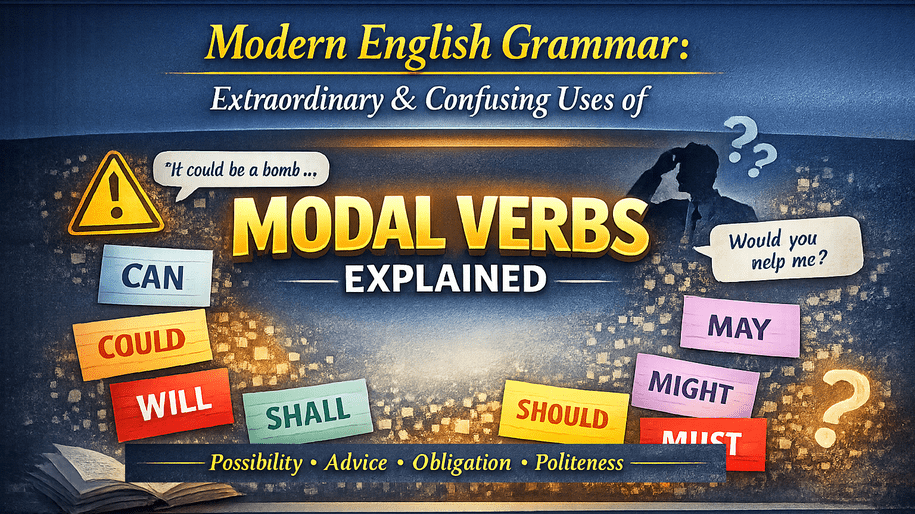
Confusing uses of modal verbs cracked with clear explanations and practical examples. Learn the extraordinary uses of modal verbs in modern English grammar including will, shall, can, could, may, might, should, must, and would. This guide explains how modal verbs express possibility, politeness,
Check your CIBIL score here: Free CIBIL Score Official CIBIL website – check score for free
Modal verbs are among the most fascinating and sometimes confusing elements of modern English grammar. Many learners first encounter modal verbs in simple grammar rules such as “can is used for ability,” “could is the past of can,” or “would is the past of will.” While these explanations are useful at the beginner level, they do not fully capture how modal verbs actually function in real communication. In everyday English, modal verbs express far more than tense. They convey attitude, possibility, politeness, assumption, obligation, probability, and even the speaker’s emotional intention.
Because of this flexibility, students often experience confusion when they encounter modal verbs in real sentences. They may wonder why a modal verb appears to be used outside the rule they learned in a textbook. The reason is simple: modal verbs are deeply connected with meaning and context rather than just time. To understand them properly, one must look beyond basic grammar formulas and examine how language works in real situations.
For example, learners are frequently taught that could is simply the past form of can. However, in modern English, could is also used to express uncertain possibility. Consider the warning sentence:
Don't touch unattended articles. It could be a bomb.
At first glance, this may seem strange to a student who has memorized that “could = past of can.” The sentence clearly refers to a present situation. The object might be dangerous right now. In this case, the modal verb could does not refer to the past at all. Instead, it expresses uncertainty or possibility. The speaker is saying that the object might possibly be a bomb.
This example shows that modal verbs do not always describe time. Instead, they often describe the speaker’s evaluation of a situation. Modal verbs therefore belong to the category of what linguists call modality—the grammatical expression of possibility, necessity, or probability.
A similar misunderstanding occurs with the modal verb would. Many students initially learn that would is simply the past form of will. While this is sometimes true, the verb would also performs several other important functions in English.
Consider the sentence:
Would you help me?
This sentence does not refer to the past. Instead, it is a polite request. English speakers frequently use would in order to soften a request and make it sound respectful and courteous.
Another example demonstrates a different use of would:
When we were children, we would play in the park every evening.
Here, would describes a repeated action in the past. It refers to a habitual activity that happened regularly when the speaker was young.
These examples illustrate an important principle: modal verbs cannot be fully understood by memorizing simple rules. Instead, their meaning depends heavily on context and intention. Once learners begin to observe how modal verbs function in authentic language, many of their apparent irregularities become much clearer.
The purpose of this article is to explore these extraordinary uses of modal verbs in modern English grammar. By examining modal verbs such as will, shall, can, could, may, might, should, must, would, and others, we can see how they function not only as grammatical tools but also as expressions of human thought and intention.
Traditional grammar once taught a strict rule regarding the use of will and shall. According to that rule, shall should be used with the first-person subjects I and we, while will should be used with second- and third-person subjects. Although this rule appeared in many classical grammar books, it is rarely followed in everyday modern English.
Today, the modal verb will is commonly used with nearly all subjects to express the simple future.
I will go there tomorrow.
She will arrive in the evening.
They will start the meeting soon.
In these sentences, will simply indicates a future action.
However, modal verbs often express more than time. When the speaker wishes to emphasize determination, promise, authority, or threat, the choice between will and shall can become meaningful.
You shall get your reward.
This sentence expresses a promise.
You shall be punished.
This sentence expresses a threat or authoritative decision.
Similarly, the modal verb will can express determination or strong intention.
I will finish this work today.
In this case, the speaker is emphasizing personal determination rather than simply describing the future.
One of the most interesting features of modal verbs is that a single expression in one language may correspond to several different modal verbs in English. Consider the Hindi expression meaning “can” or “be able to.” Depending on the context, English may require different modal verbs to express different shades of meaning.
When the sentence refers to ability, the modal verb can is used.
He can solve this problem.
This sentence clearly indicates that the person has the ability to solve the problem.
When referring to ability in the past, the modal verb could is often used.
When he was young, he could run very fast.
However, could is also used in modern English for polite requests.
Could you open the window?
In this sentence, the modal verb softens the request and makes it more polite.
Another modal verb, may, is commonly used to express permission or possibility.
You may enter the room.
This sentence grants permission.
The modal verb might is often used to express weaker or more uncertain possibility.
It might rain tonight.
In this case, the speaker believes that rain is possible but not certain.
Through these examples we see that modal verbs allow English speakers to express subtle differences in meaning that may not exist in other languages.
The modal verbs should, ought to, and must all express the idea of obligation or necessity, but they differ in strength and tone.
The modal verb should usually expresses advice or recommendation.
You should read this book.
The speaker suggests that reading the book would be a good idea.
The modal verb ought to expresses moral duty or ethical obligation.
We ought to respect our parents.
This sentence refers to moral responsibility rather than simple advice.
The modal verb must expresses strong necessity or obligation.
You must follow the rules.
Here the action is not optional; it is required.
These distinctions demonstrate how modal verbs communicate different degrees of obligation.
The modal verb would is one of the most versatile modal verbs in English. It appears in many different contexts.
One of its most common uses is in polite requests.
Would you help me with this task?
Another use appears in conditional sentences.
If I had more time, I would travel around the world.
Here the modal verb expresses a hypothetical situation.
In addition, would can describe repeated actions in the past.
During summer vacations, we would visit our grandparents every year.
This use is similar to “used to.”
Modal verbs are also used to make assumptions about past events. This structure typically uses have + past participle.
He must have reached home.
This sentence expresses strong probability.
She may have forgotten the meeting.
This sentence expresses moderate possibility.
They might have missed the train.
This sentence expresses weaker possibility.
These structures allow speakers to logically infer what may have happened in the past.
Another important expression related to modal verbs is had better. Although it resembles a past form, it actually refers to present or future advice.
You had better leave now.
This expression often implies that ignoring the advice could lead to negative consequences.
Modal verbs play a crucial role in modern English communication. They allow speakers to express possibility, necessity, obligation, politeness, probability, and intention with remarkable precision.
Many learners initially struggle with modal verbs because they try to interpret them strictly as tense markers. However, modal verbs are better understood as tools for expressing attitude and meaning rather than simply time.
When students learn to analyze modal verbs in terms of context, intention, and probability, the language becomes clearer and more logical. What once seemed confusing becomes a powerful system for expressing subtle shades of meaning.
Understanding these extraordinary uses of modal verbs therefore enables learners to communicate more effectively, more accurately, and more confidently in modern English.








Download worksheets and assignments for better practice and revision.